Evening, or Lost Illusions
Details
The story
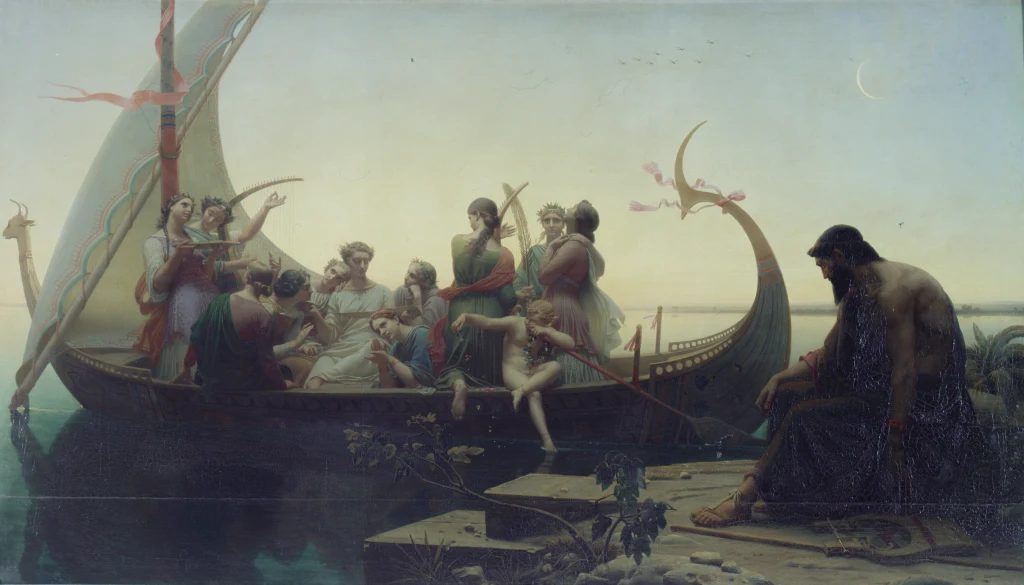
On the evening of 21 March 1835, on the bank of the Nile near Abydos, Charles Gleyre had a vision, and he wrote it down in his journal. Eight years later in Paris he turned it into this canvas and sent it to the Salon of 1843 under a plain title, Evening. An old man sits alone on the shore at dusk while a boat full of young people making music drifts away from him across the water. Visitors read it at once as the boat of life leaving him behind. Arsène Houssaye, a writer reviewing the Salon, seems to have been the first to call it Lost Illusions, after Balzac's novel, whose final part appeared that same year, and the new name pushed out the old one. King Louis-Philippe bought the picture after the exhibition, and it went to the Luxembourg, the Paris museum for living artists. Copyists set up their easels in front of it there by the hundreds, and in 1858 an engraving published by the Goupil firm carried the image into homes far beyond Paris.