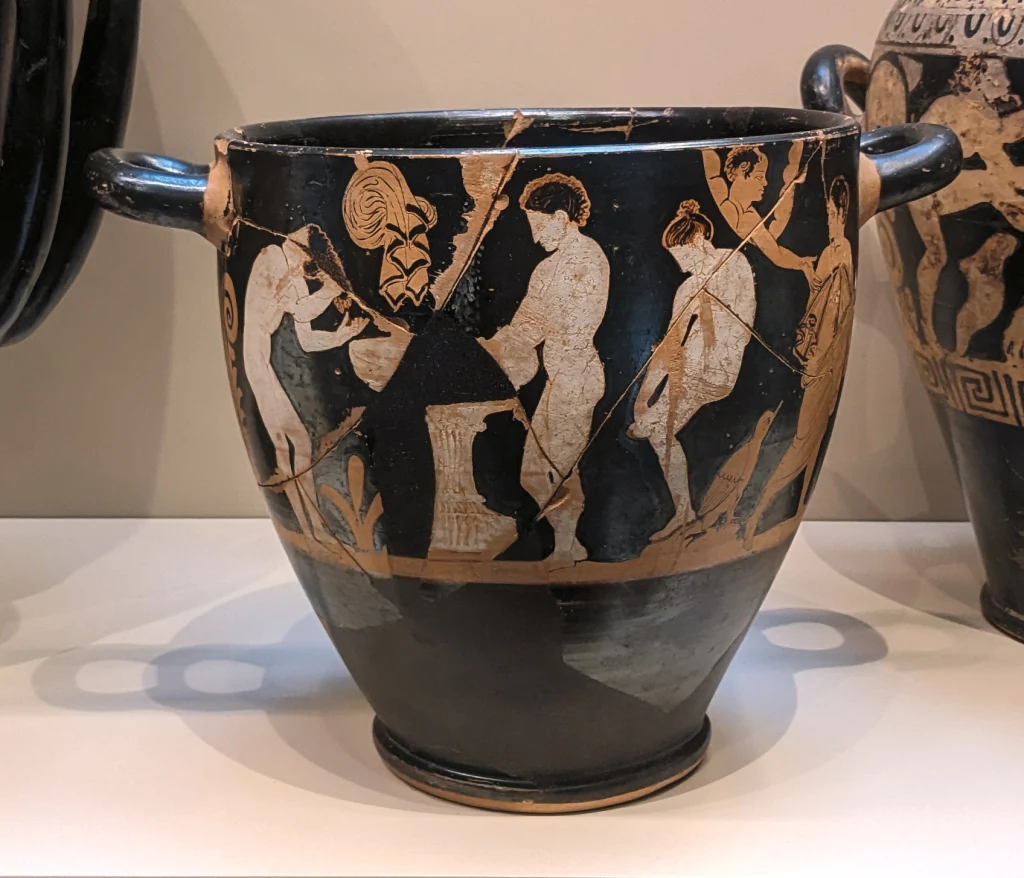
Faliscan Red-Figure Skyphos with a Toilette Scene
Details
The story
When this deep drinking cup was painted, between about 360 and 350 BC, Falerii was a prosperous town on a rock plateau some 50 kilometres north of Rome, and still independent of it. Its potters had taken up red-figure painting from Athenian vases, possibly with the help of painters trained in Athens, and through the 4th century BC their workshops supplied cups and bowls for local banquets and tombs. Rome destroyed the town in 241 BC and moved its people to a new site on the plain.
The Louvre describes the scene on the front as a toilette scene, with a question mark. A naked woman bends over a washbasin on a tall stand, a naked man is washing, and another woman, her hair in a bun, ties her sandal with one foot on a stone beside a partridge. Above them the bust of a satyr pushes out of an opening and reaches toward a half-draped man holding a wreath. On the back two men flank a figure who may be Apollo, and a reclining youth blows a trumpet. The skyphos came to the Louvre with the collection of the Marquis Campana, a Roman collector whose holdings were bought for France in 1861, and it has been put back together from fragments.