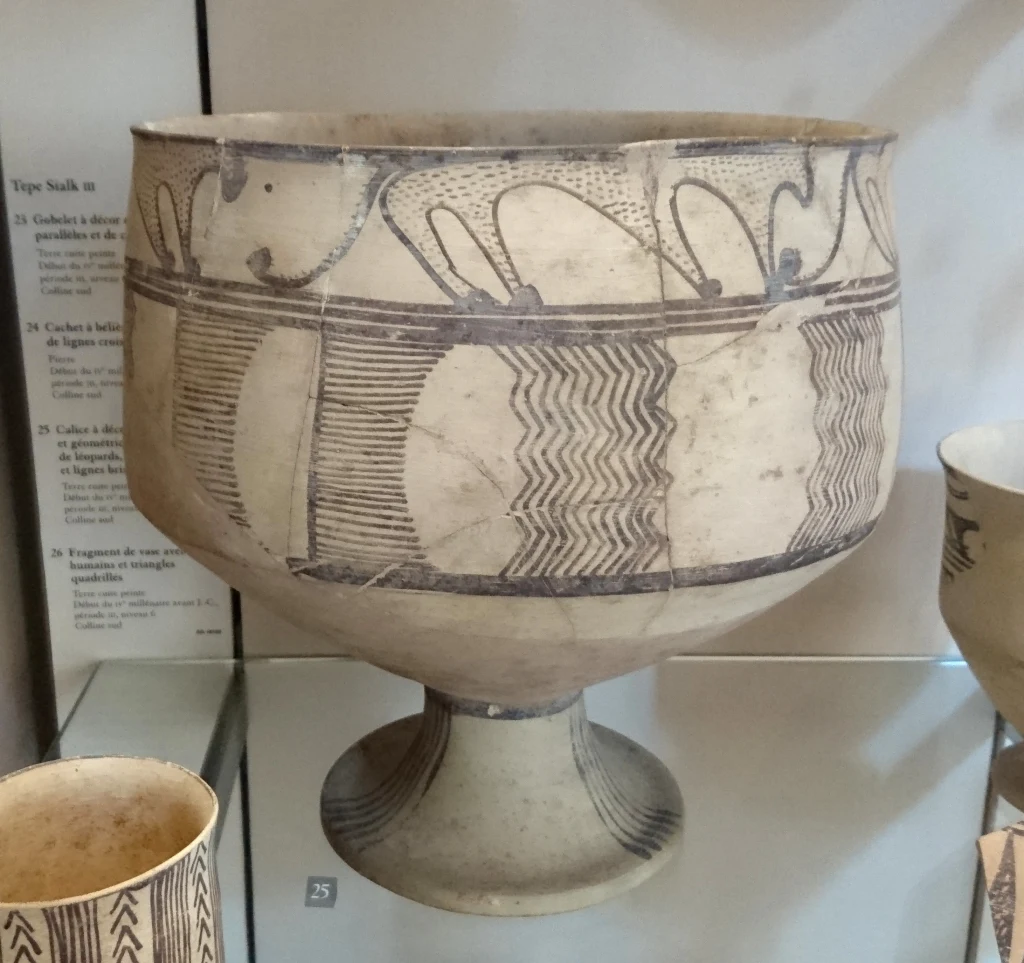
Footed Chalice with a Frieze of Leopards, from Tepe Sialk
Details
The story
This chalice was made in the first half of the 4th millennium BC, centuries before anyone in the Near East had begun to write. Its potter lived at Tepe Sialk, a settlement beside a spring near today's Kashan, on the edge of the central Iranian desert, and painted a frieze of leopards round the rim. Below them run bands of zigzags and parallel lines, and the whole bowl stands on a flaring foot, almost 28 centimetres tall.
Animals like these leopards, along with goats, birds and cattle, are typical of the painted wares from the phase archaeologists call Sialk III. The chalice came out of the ground during the excavations of the French archaeologist Roman Ghirshman, who dug at Sialk with his wife Tania in 1933, 1934 and 1937. The finds were shared between Iran and France, and this one came to Paris, where Ghirshman published it in his report on the site under his excavation number, S 152.