Peter Paul Rubens · PD
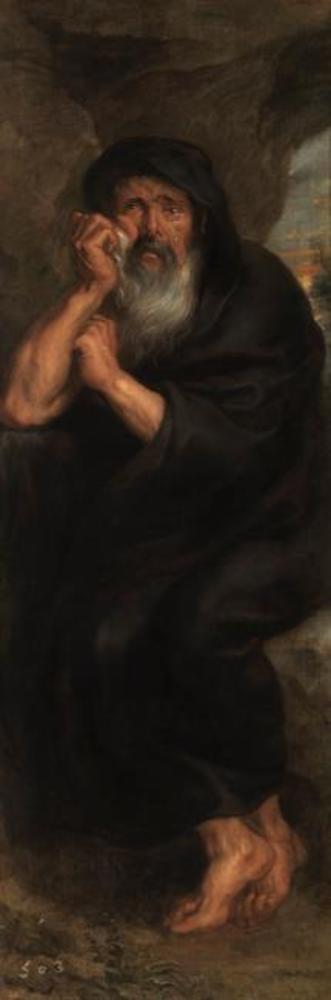
Heraclitus, the Crying Philosopher
Details
The story
The museum's inventory of 1857 has this figure down as the prophet Jeremiah, withdrawn to a cave to mourn the ruin of Jerusalem. He is Heraclitus, the philosopher antiquity remembered as the one who wept, and he was never meant to hang alone. His pair is Democritus, the one who laughed, in bright red with a globe beside him. Both are first recorded in the inventory taken at the Torre de la Parada after Charles II died in 1700, listed as two equal paintings, one Democritus and one Heraclitus, by Rubens's hand. The Prado now gives the painting itself to his workshop, working from his design. Of the 60 and more canvases sent from Antwerp for that hunting lodge in the El Pardo hills between 1636 and 1638, these two are the only ones showing historical people instead of gods. Heraclitus wears dark cloth with a hood pulled over part of his head, and everything about him is drawn in, down to the way he sets his feet.