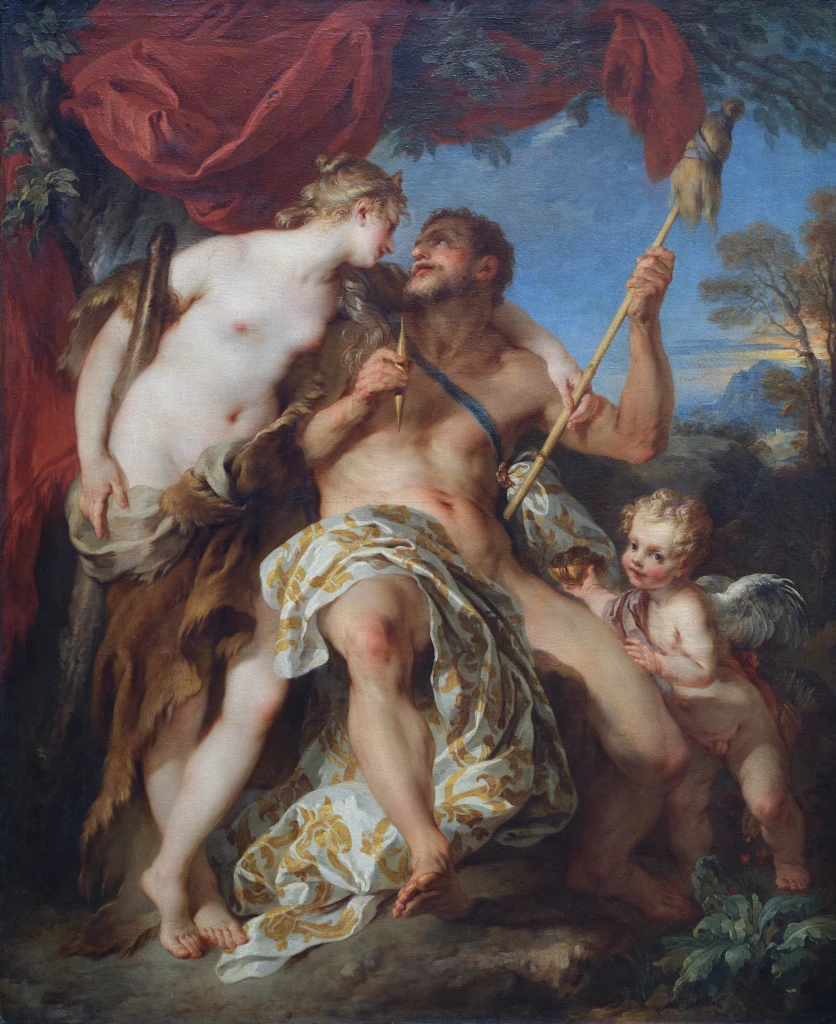
Hercules and Omphale
Details
The story
In the myth, Hercules was sold as a slave to Omphale, queen of Lydia, as penance for a killing, and the two ended up trading places. Lemoyne paints the swap already complete. Omphale has taken the lion skin and the hero's club, and Hercules, close beside her, holds her distaff and spindle, the tools a woman used to spin wool. Cupid watches from the right.
The picture was ordered by François Berger, a wealthy patron and friend of the painter, who already owned Lemoyne's Perseus and Andromeda, now in the Wallace Collection in London, and wanted a companion for it. Lemoyne painted it in Rome in 1724 and signed and dated it at the lower left. Before Parisians had even seen it, it inspired a poem printed in the Mercure de France, the leading literary monthly. It was shown at the Salon in 1725, and in 1728 the engraver Laurent Cars made a print of it that carried the composition much further.
It reached the Louvre in 1869 with the bequest of Louis La Caze, a doctor who left the museum more than 500 paintings.