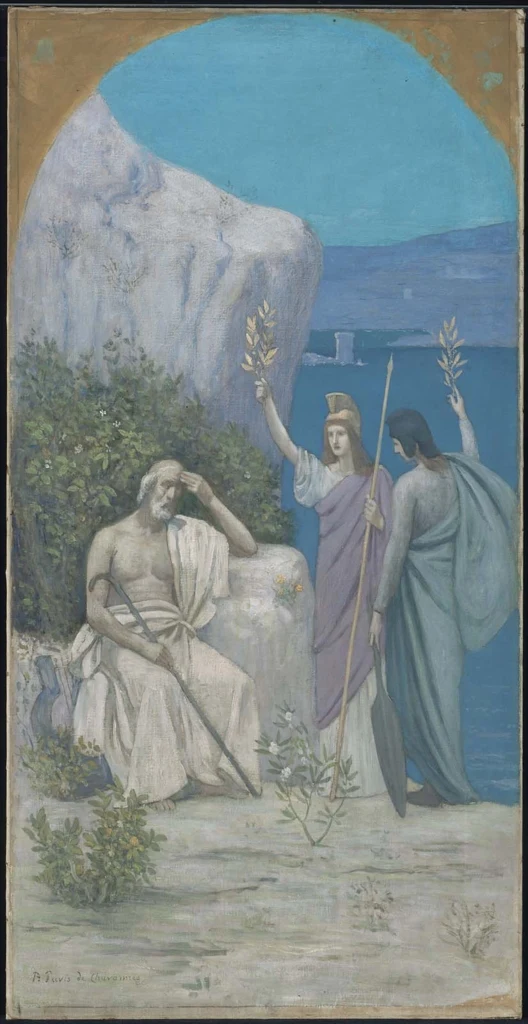
Homer: Epic Poetry (reduction of a mural in Boston Public Library)
Details
The story
In 1891 Charles McKim, the New York architect who was building a new public library on Copley Square in Boston, went to Paris to ask Puvis de Chavannes to decorate its grand staircase. Puvis was well into his sixties and had no wish to cross the Atlantic, so the library came to him instead. He was sent a plaster model of the interior and a sample of the yellow Siena marble that lines the stairs, so that he could match his colours to the stone. He painted on linen in Paris, the canvases were shipped over in 1895 and 1896 and pasted onto the walls, and he never saw them in place. Around the staircase he set eight panels for branches of learning. For epic poetry he chose Homer, the blind poet, seated between two figures who stand for his poems, the Iliad holding a spear and the Odyssey an oar. This canvas is a smaller repetition of that panel, still tall and narrow like the wall it copies. Puvis sold it to his dealer Durand-Ruel in 1896, and in March 1897 a Boston collector, Clara Bertram Kimball, bought it from the firm's New York branch. Her husband left it to the Museum of Fine Arts in 1923, one of 40 paintings from her collection, and so a copy of the Homer came to rest a short walk from the staircase where the full-size panel still hangs.