Judith and Holofernes
Details
The story
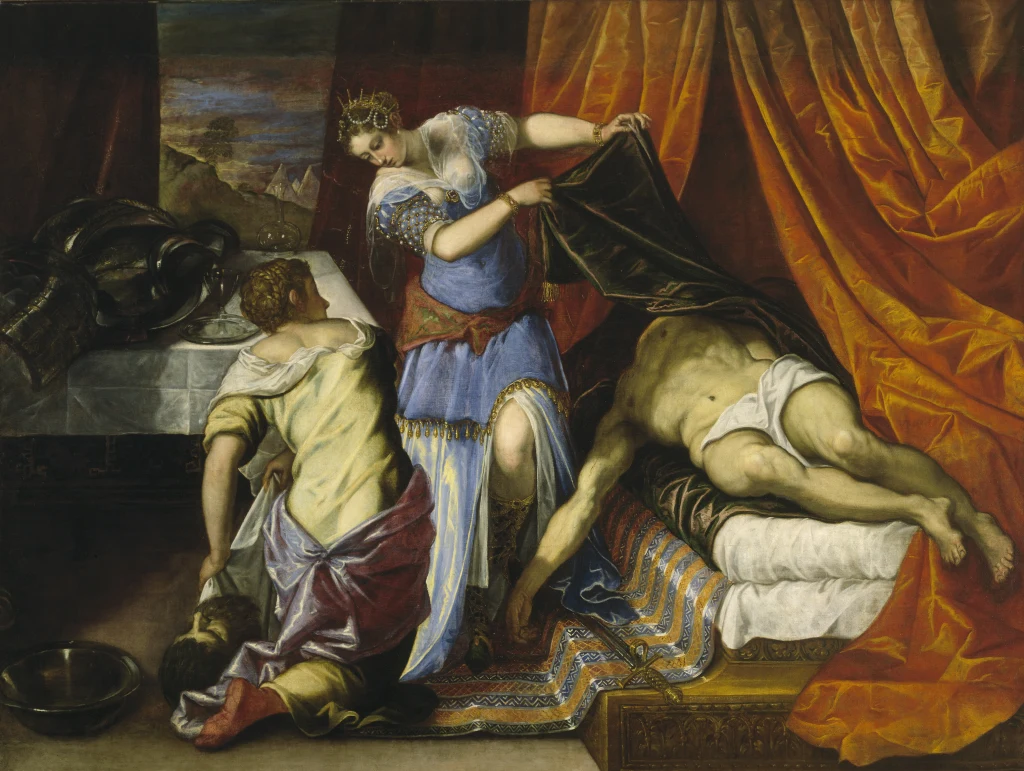
The canvas is signed on the step under the bed, IACOMO TENTORETO FAC., and the Prado still files it under the workshop of Jacopo Tintoretto rather than the master's own hand. Generations read it as something he painted young. Current scholarship puts it around 1577, when Tintoretto was in his late fifties and the family shop was at full stretch.
Judith comes from a book of the Old Testament that Catholic and Orthodox bibles keep and Protestant ones set aside. Her town, Bethulia, is under siege by an Assyrian army. She walks into the enemy camp, is received by the general Holofernes, waits until he is drunk, and beheads him with his own sword.
Venetian painters tended to choose the minutes after that, and those are the minutes here. Holofernes lies on the bed at the left. The sword is on the floor with blood on it. A maidservant is working the head into a sack. Judith stands in the middle of the tent still in the good clothes she had put on to get herself admitted, where Italian painters of the period more often showed her undressed.
The bed runs off at a steep angle and the figures are seen sharply from below because the canvas was made to hang high on a wall. It belonged to the marquis of la Ensenada in Madrid until 1768 and was bought for the Spanish crown by Carlos III the year after.