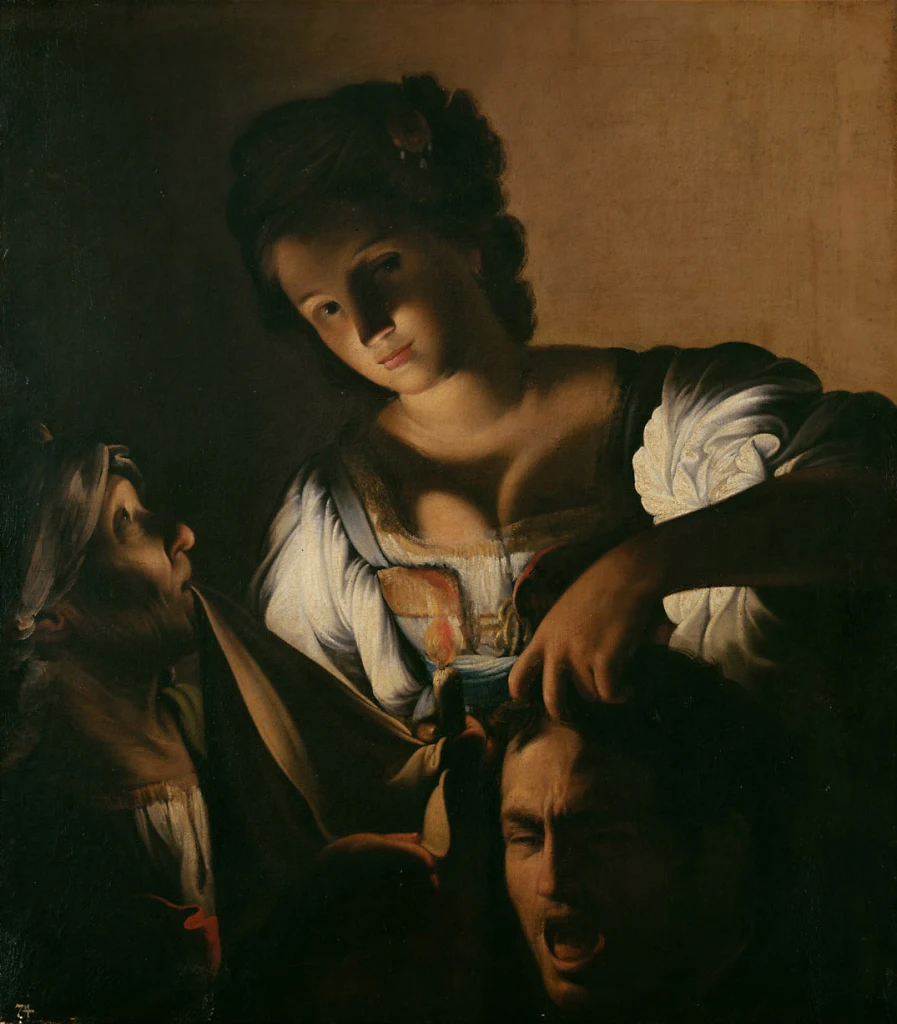
Judith with the Head of Holofernes
Details
The story
An old woman holds a sack open, and a young one is about to lower a man's head into it. A single candle lights them both, the girl's smooth face and the servant's lined one, and leaves the tent around them in darkness. This is Judith, the widow from the Bible who saved her town by beheading the Assyrian general Holofernes, and Saraceni painted her in Rome around 1610 to 1615. The composition sold well enough that a second version by his own hand exists, now in the Dayton Art Institute in Ohio. This canvas travelled a long way afterwards. By 1636 it belonged to the Venetian collector Bartolomeo della Nave. Two years later agents of the Scottish Marquis of Hamilton bought up della Nave's pictures, and after Hamilton was executed in London in 1649, many of them went to the Habsburg archduke Leopold Wilhelm, governor of the Spanish Netherlands. His court painter David Teniers had this Judith engraved for the printed catalogue of the archduke's Italian pictures.