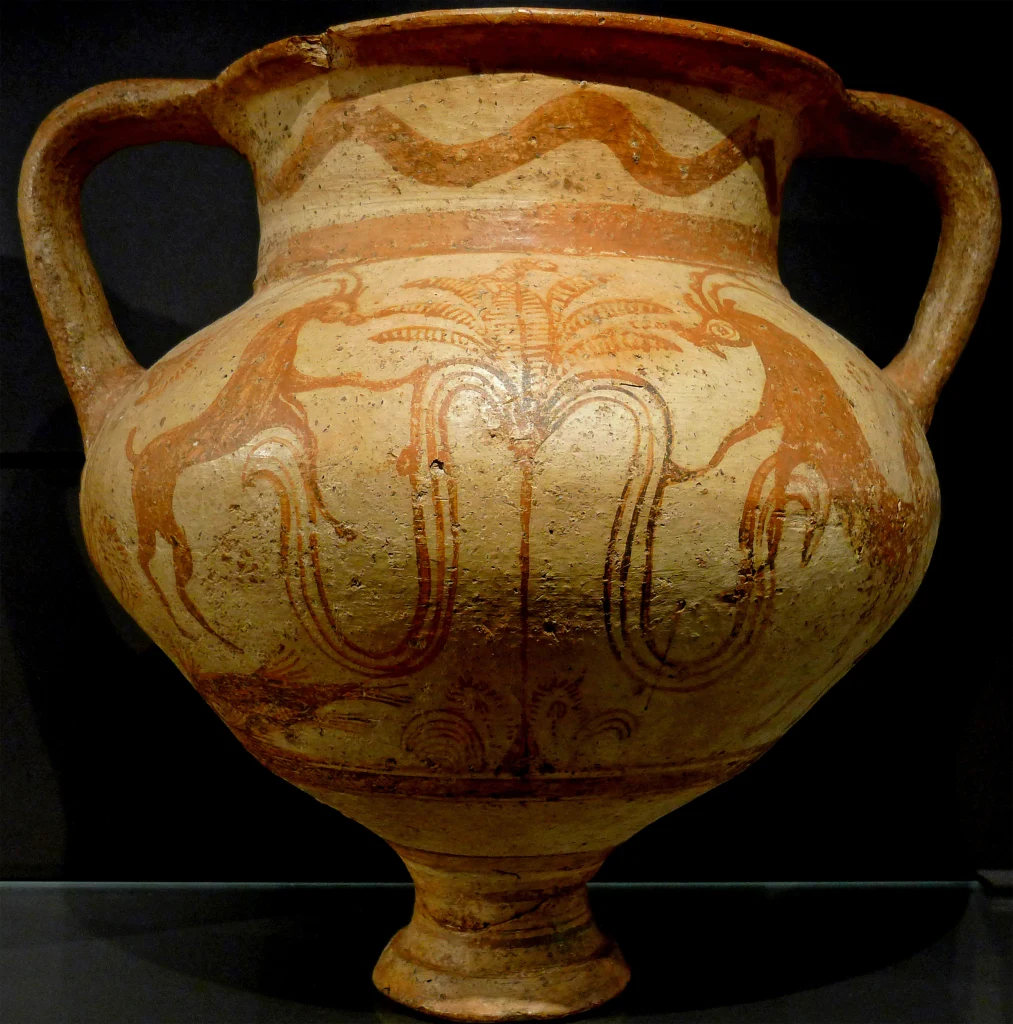
Krater with Ibexes Flanking a Palm Tree
Details
The story
In January 1895 Ahmet Effendi Mostaixakis, the schoolteacher of the Turkish village of Ligortyno in south-central Crete, found a chamber tomb in the hillside near his village. Crete was still part of the Ottoman Empire. A second tomb next to it was found later, and this krater stood at its far end, opposite the entrance. Arthur Evans came to see the finds in 1896, years before he dug at Knossos, but it was the French scholar Charles Clermont-Ganneau who bought the finds for the Académie des Inscriptions in Paris, and they entered the Louvre in November 1896.
On the main side two wild goats, the agrimia of Crete, rear up on either side of a palm tree with a bird on top, among flowers and a fish. One is young, the other older and bearded, and a small kid stands beside him. The archaeologist Anna Lucia D'Agata has read the three ages as the generations of a family, a fitting picture for a grave.
The Louvre dates the krater to the 14th century BC. D'Agata puts it slightly later, at the start of the 13th.