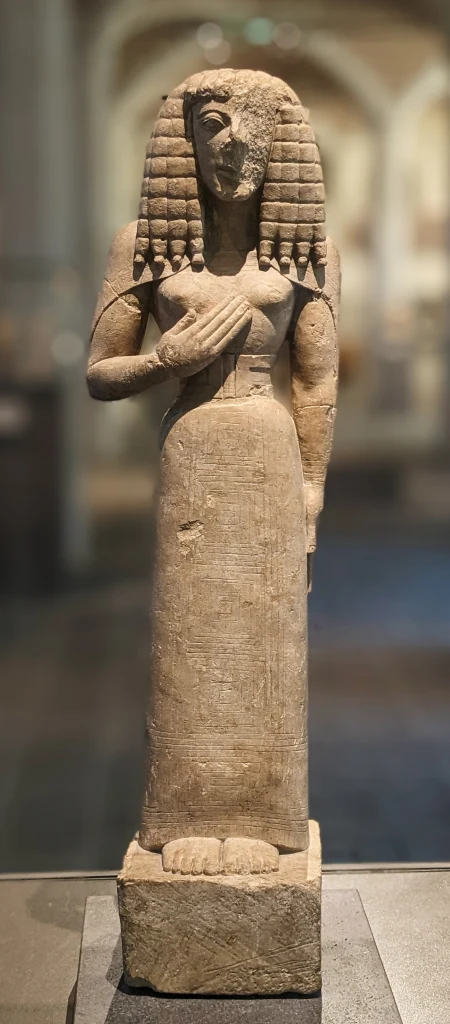
Lady of Auxerre
Details
The story
Around 630 BC, sculptors on Crete were among the first Greeks to carve standing figures in stone, and they borrowed freely from Egypt and the Near East. You can see it in her hair, which falls in stacked horizontal layers like an Egyptian wig. The style is named after Daedalus, the legendary craftsman of Crete. Her long dress carries incised meanders and scales, and traces of red paint survive on her chest.
How she reached France is unknown. She belonged to Édouard Bourgoin, a Paris artist and dealer who had retired near Auxerre. At his estate sale in 1895 she was reportedly bought for one franc by the concierge of the town's theatre, as a stage prop. In 1907 the scholar Maxime Collignon spotted her in the entrance hall of the Auxerre museum, and in 1909 she came to the Louvre in an exchange.