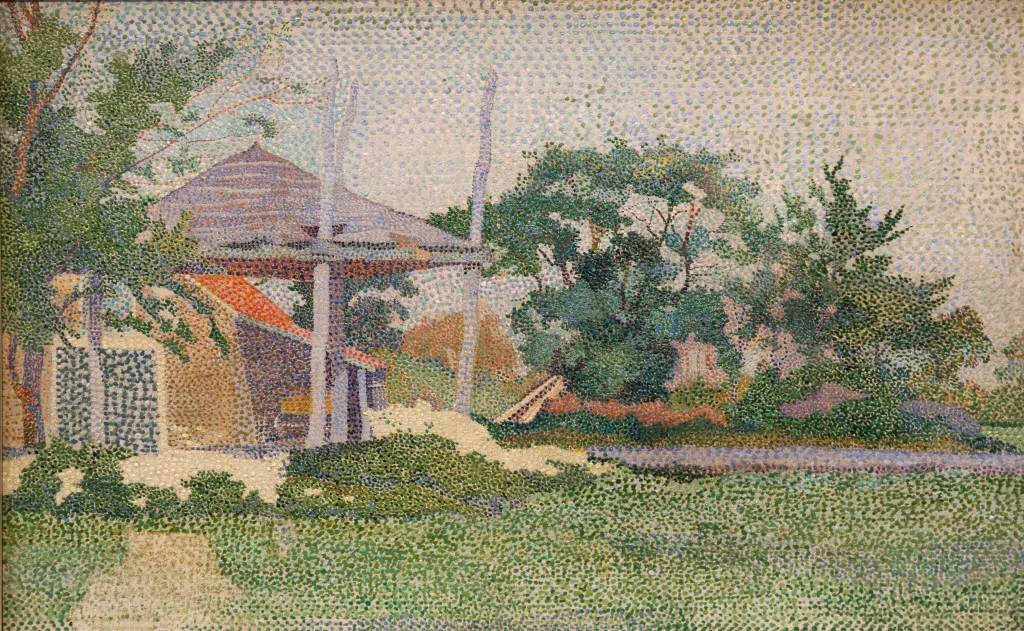
Landscape with Haystack
Details
The story
In 1892 a Belgian avant-garde group called Les Vingt sent their paintings to The Hague, and for a small circle of young Dutch artists it was the first close look at neo-impressionism, landscapes and figures built entirely from separate dots of unmixed colour. Jan Vijlbrief was one of the painters it reached. By about 1894, when he made this small canvas, barely 30 by 45 centimetres, he was already setting his colours down in that dotted, divisionist way, a method still almost unheard of in Dutch painting. The subject could hardly be plainer. A haystack in an open field, the kind of motif Dutch painters had put on canvas for generations. What is new is the handling. The field and sky are worked up from small touches of colour placed side by side rather than blended, so the greens and warmer tones mix in the eye instead of on the palette. The painting hangs today in the Kröller-Müller Museum in Otterlo, whose collection is especially rich in the Dutch painters who took up this French technique in the 1890s.