Landscape with the Pilgrims to Emmaus and the Allegory of the Two Flocks
Details
The story
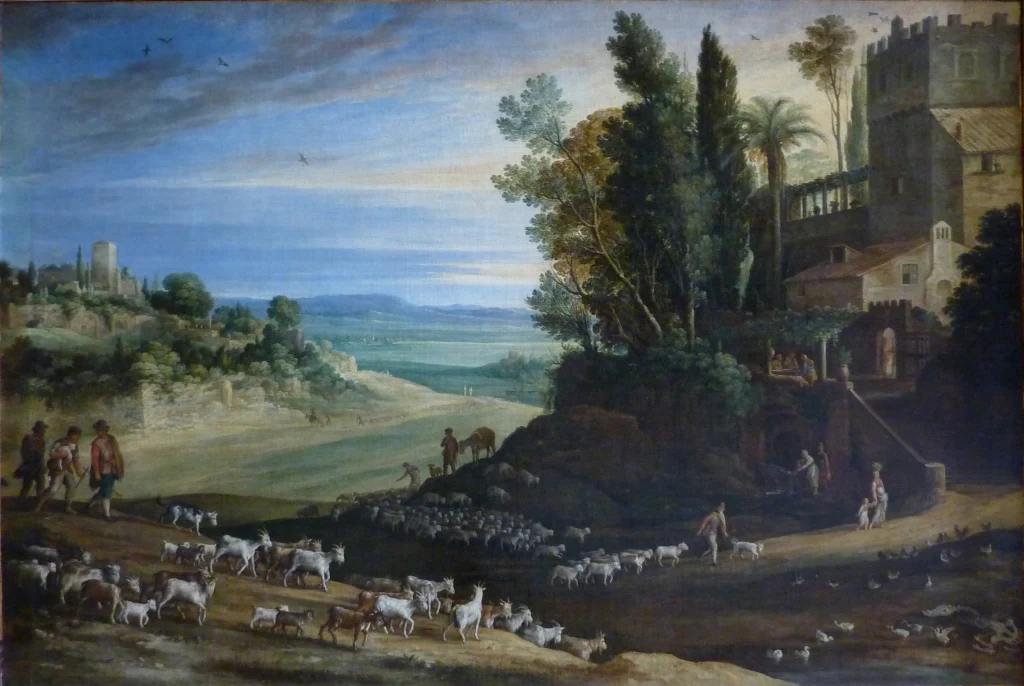
The story in the title is the smallest thing here. Under a pergola beside a palm tree, Christ sits at table with the two disciples he met on the road to Emmaus, on the evening they recognised him after the Resurrection. Most of the canvas belongs to the animals. Across the foreground the flocks have parted, sheep on one side and goats on the other, and the goats are making for the skeleton of a horse. The Louvre reads this as the parable in the Gospel of Matthew where, at the Last Judgement, the righteous are separated from the wicked as a shepherd separates the sheep from the goats. The palm stands for justice, and the spring directly below Christ marks him as the source of life.
Bril signed and dated the canvas 1617, when he was in his sixties. The design clearly found buyers. Other versions exist, one of them in the Pitti Palace in Florence, and this picture or one very like it hangs in the background of a painting by Willem van Haecht of around 1631, which shows the picture gallery of the Antwerp collector Cornelis van der Geest.