Paul Cézanne · PD
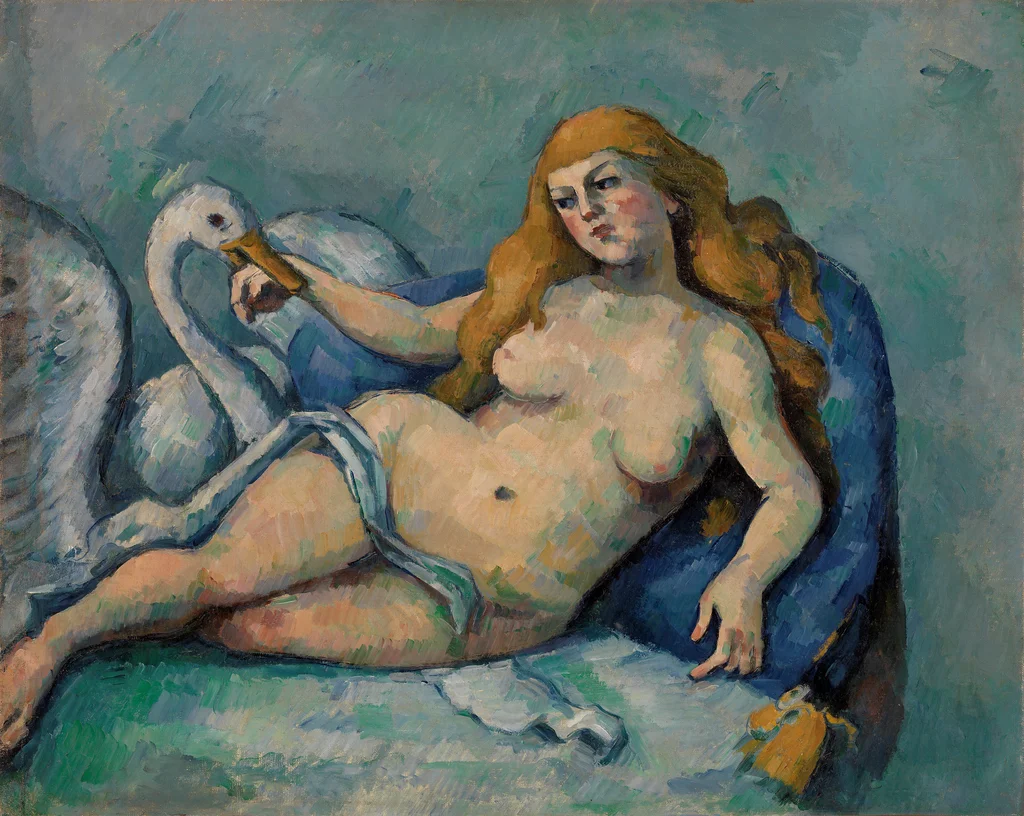
Leda and the Swan (Léda au cygne)
Details
The story
The story comes from Ovid. Zeus takes the shape of a swan to reach Leda, a queen of Sparta, and since the Renaissance painters had used it as a reason to paint a nude. For Cézanne it is a rare thing, one of very few pictures he tied to a specific tale from literature. Nobody agrees on when he painted it. His dealer Ambroise Vollard and old archive notes put it as early as 1868, the scholar John Rewald around 1880 or later, and Lionello Venturi, who compiled the first catalogue of Cézanne's work, moved it to 1888 to 1890. The Barnes Foundation settles on about 1880, possibly later. Cézanne made two drawings for the composition, and in one of them the woman holds a champagne glass. In the painting the swan's beak closes around her wrist. Albert Barnes bought the canvas through a Paris dealer in January 1937.