Peter Paul Rubens · PD
Leda and the swan
Details
The story
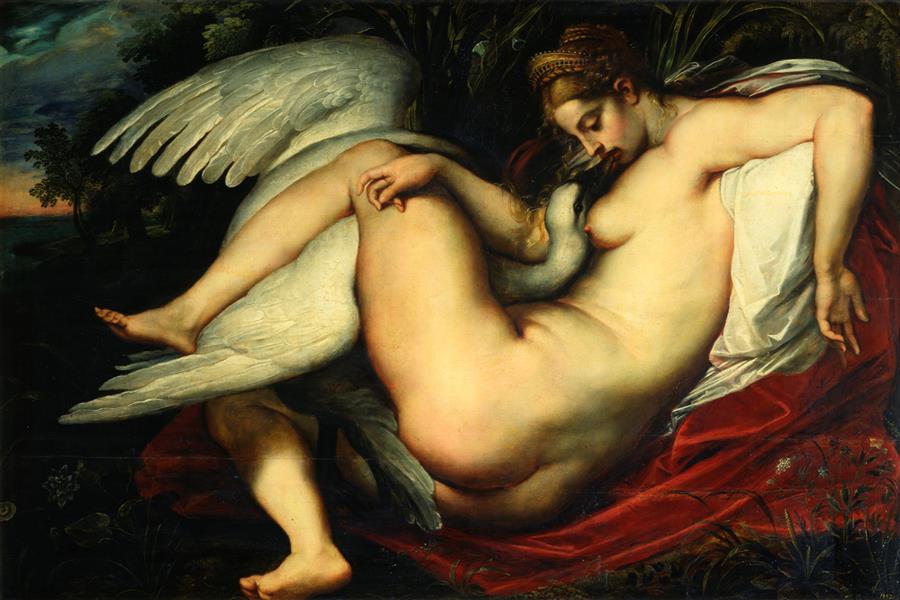
Around 1530 Michelangelo painted Leda and the swan for Alfonso d'Este, Duke of Ferrara. The duke never received it. Michelangelo gave the picture to his assistant Antonio Mini, who took it to France, where it was later lost. From then on the composition was known mainly through copies and engravings, and that is how Rubens knew it. His panel follows the famous pose: Zeus, disguised as a swan, embracing Leda, wife of the king of Sparta, who in the myth then lays the egg from which the twins Castor and Pollux hatch. Some scholars have placed the picture in Rubens's Italian years. The Dresden gallery dates it to about 1598 to 1600, before he left Antwerp, partly because it is painted on oak, the support he used at home. Along the lower edge, the plants and small flowers are painted with the care of a Flemish still life.