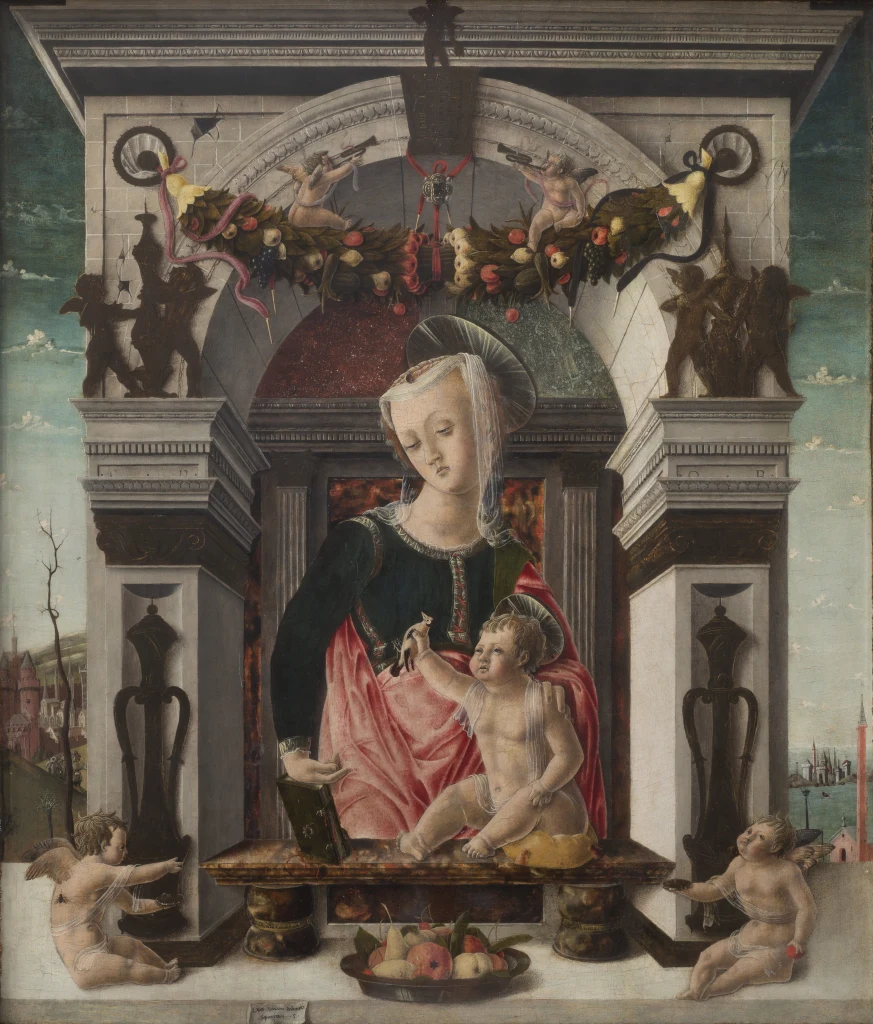
Madonna and Child
Details
The story
Along the bottom of this panel runs the painter's signature, 'opus sclavoni dalmatici squarzoni', the work of the Dalmatian Slav, Squarcione's. He named himself through his master, Francesco Squarcione, in whose Padua workshop he trained, and the panel is dated between 1456 and 1459, while he was still there.
Padua in those years was full of new sculpture and painting. A few years earlier Donatello had finished his bronzes for the high altar of the Santo, and Andrea Mantegna was at work in the Ovetari chapel. The museum sees both in the marble shrine around the Virgin and Child, with its putti, candelabra, vases and the garland of fruit hanging in the arch, ornaments drawn from ancient models that Squarcione kept in his shop. On the parapet in front, balanced at the very edge, stands a dish of pears, apples and lemons, which the museum calls one of the finest passages in all of Schiavone's work, a still life before the name existed. The gallery bought the panel in 1879 from Count Benucci of Senigallia.