Man of Sorrows
Details
The story
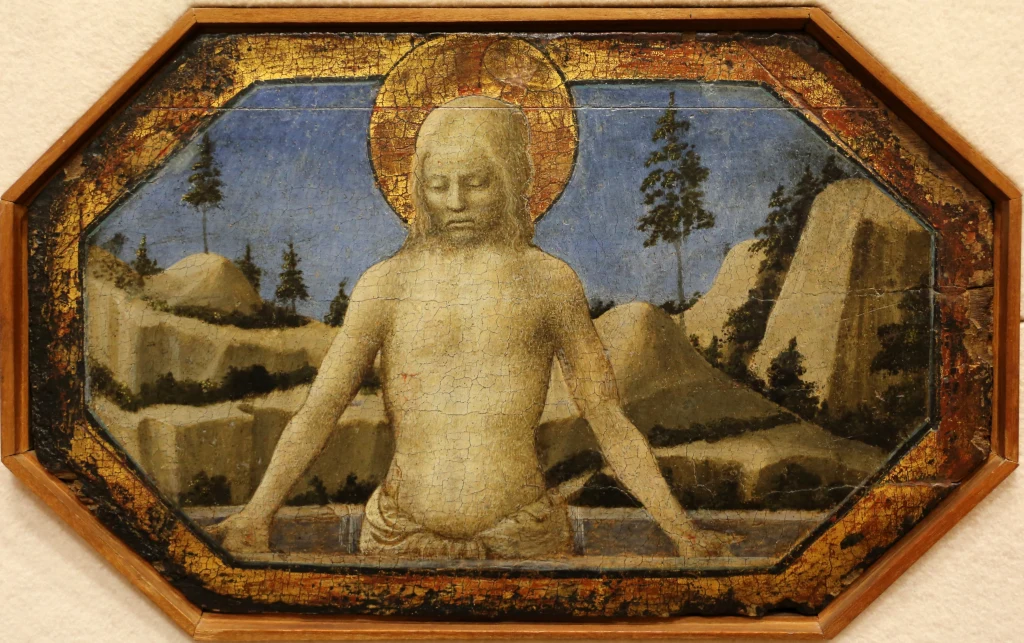
In 1434 Filippo Lippi, a young Carmelite friar from Florence, is recorded in Padua. He painted there for the great basilica of Saint Anthony, the Santo, and for the palace of the city's governor, and all of that work is lost. The museum considers this small panel the only surviving trace of those Paduan years. It finds in it an unusual balance between the painting of the Veneto and the manner of the Tuscan masters who were then working in the region.
It is barely 35 centimetres wide, an element from a predella, the strip of small scenes beneath an altarpiece. The dead Christ stands upright in his tomb, eyes lowered, his arms resting along its edge, against a landscape of pale rocks and dark fir trees inside an eight-sided frame. The museum also calls it an Entombment. It came to Castelvecchio in 1911 with the collection of the Monga family of Verona.