Minister Kibi's Adventures in China (Kibi daijin nittô emaki)
Details
The story
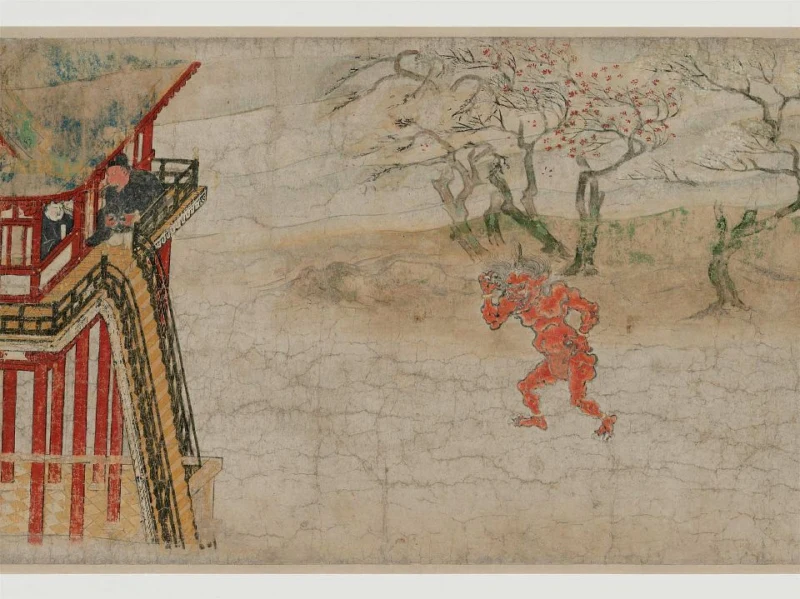
In 1932 the Museum of Fine Arts in Boston bought this scroll, and in Japan the sale caused an outcry. For generations it had belonged to the Sakai, lords of Wakasa province on the Sea of Japan, who had probably acquired it from a local Hachiman shrine. In 1923 the family put it up at auction in Tokyo, where the Osaka dealer Toda Yashichi paid 188,900 yen. In 1932 his son sold it to Boston through the dealers Yamanaka. The purchase was arranged by the museum's Japanese-born curator Kōjirō Tomita and paid for with money raised by exchanging objects from the collection of William Sturgis Bigelow, the Boston doctor who had brought home thousands of Japanese works in the 1880s. The protest in Japan was strong enough to change the law. In April 1933 a new act on the preservation of important works of art made government permission necessary before such objects could leave the country. The scroll itself was painted in the 12th century. It tells a legend about Kibi no Makibi, an 8th-century envoy to the Tang court in China. Officials there lock him in a tower and set him tests of learning and of the board game go, and he passes them with help from the ghost of an earlier Japanese envoy, Abe no Nakamaro, who visits him in the shape of a red demon. When it reached Boston it was a single scroll more than 24 metres long. It was remounted as four scrolls in 1964, when it went back to Tokyo for an exhibition held to mark the Olympic Games.