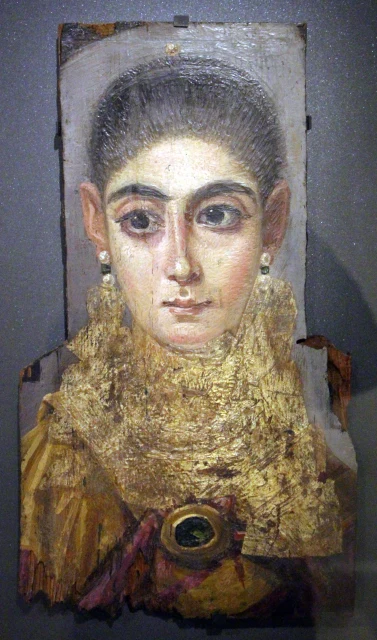
Mummy Portrait of a Woman
Details
The story
When Paula Modersohn-Becker came back to Paris in 1903, the young German painter went to the Louvre again and again, and what held her there were the mummy portraits of Roman Egypt, faces painted on wooden boards and laid over the dead in their wrappings. From them she took the frontal pose, the tight framing and the wide-open eyes of her late self-portraits. This woman was already in the museum then. The Louvre had bought her in 1893 from the collector Albert Daninos Pasha, one of five portraits that probably came from Philadelphia, a town founded by the Ptolemies on the edge of the Fayum oasis.
Ever since, she has been picked whenever someone wanted to show what modern artists saw in these faces. André Malraux reproduced her in his books on art, and she appears in exhibition catalogues on Matisse, Giacometti, Picasso and Modersohn-Becker herself. She travelled to Rome for the Matisse show in 1997 and to Louvre-Lens for the Picasso one in 2021.
She is painted in coloured wax on a thin board of sycamore fig, over a black ground. A jewel sits in her hair, she wears earrings and two necklaces, and a dark blue stripe runs down her tunic. The Louvre dates her by style alone, anywhere between 150 and 350.