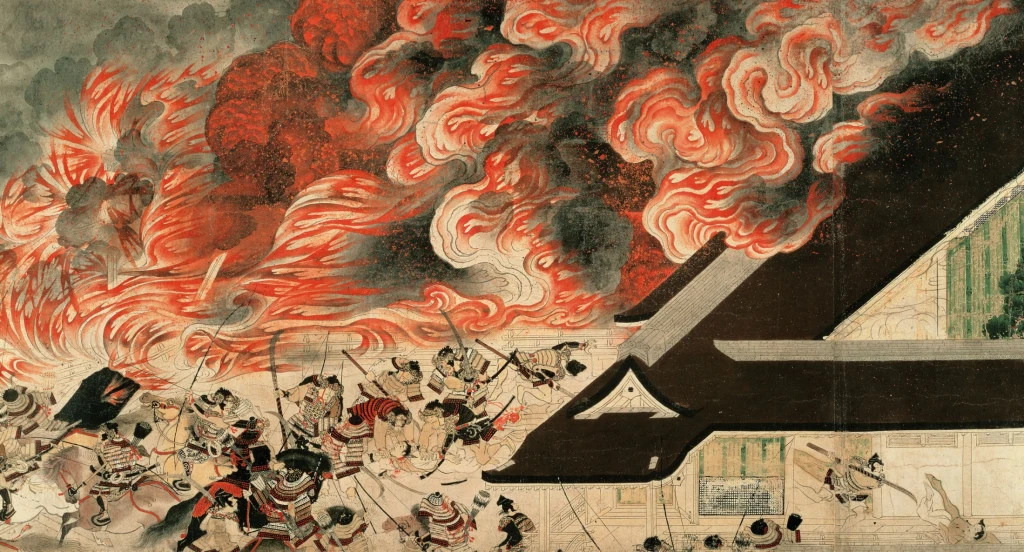
Night Attack on the Sanjô Palace, from the Illustrated Scrolls of the Events of the Heiji Era (Heiji monogatari emaki)
Details
The story
At about two in the morning on the ninth day of the twelfth month of the Heiji era, in January 1160 by our calendar, the courtier Fujiwara no Nobuyori rode with several hundred horsemen to the Sanjō Palace in Kyoto, home of the retired emperor Go-Shirakawa. With him came Minamoto no Yoshitomo, head of the Minamoto warrior clan. They forced Go-Shirakawa into an ox carriage and set the palace on fire. This scroll, painted about a century later, in the second half of the 13th century, unrolls that night from right to left over some seven metres. A single ox carriage opens the scene, then carts and warriors jam the gates, the fighting peaks at the burning palace in the middle, and at the far end the victors ride away with the heads of the defeated on their pikes. It belonged to a whole set illustrating the rebellion. Two other scrolls survive in Tokyo, with fragments of a fourth. In the early 1880s it was owned by the Honda family, and the American Ernest Fenollosa, then teaching philosophy in Tokyo, studied and photographed it at the yearly loan exhibitions of feudal lords' treasures, before buying it. In the same years he was working with his student Okakura Kakuzō on the government's surveys of temple treasures, work that fed into Japan's first laws protecting its old art. In 1886 Fenollosa sold his collection to the Boston doctor Charles Goddard Weld, and the scroll came to the museum with Weld's bequest in 1911.