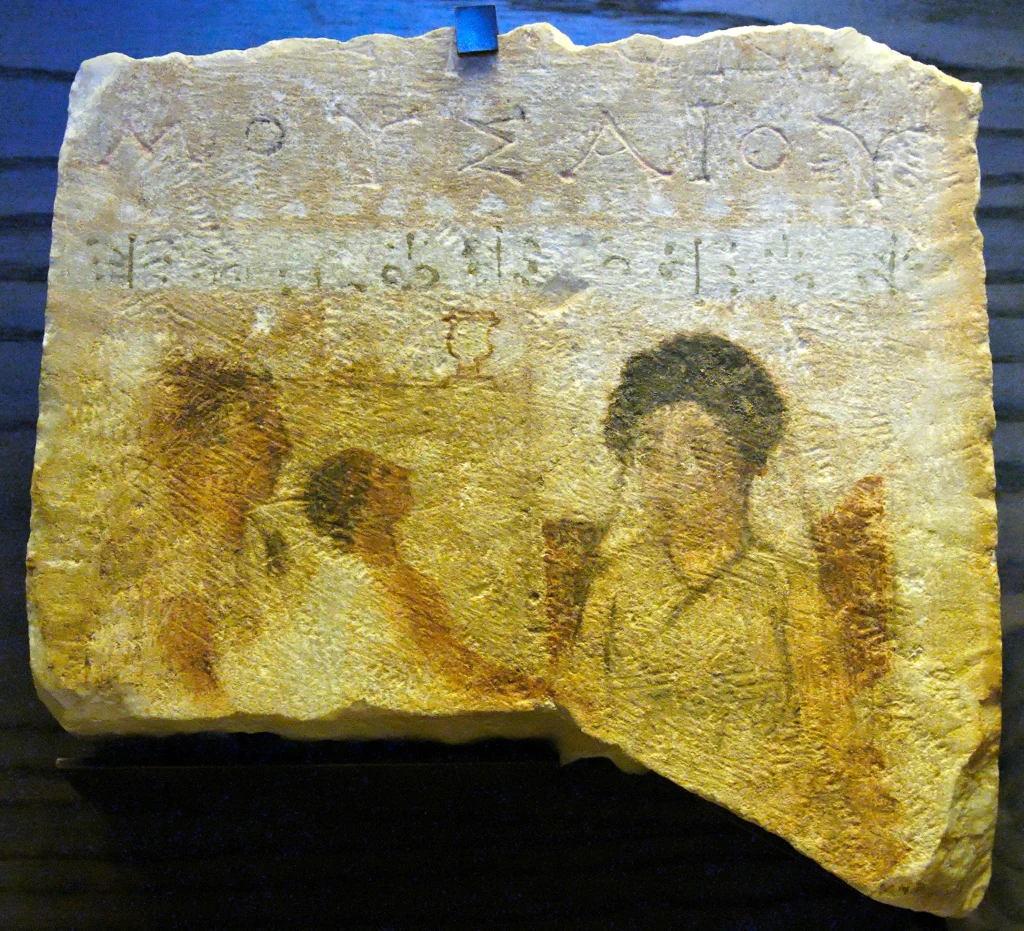
Painted Funerary Stele from Demetrias
Details
The story
Around 293 BC the Macedonian king Demetrios, nicknamed the Besieger, founded a new city on the Gulf of Volos in Thessaly and named it after himself, Demetrias. It became a royal stronghold, and its families marked their graves with marble slabs painted in colour. This is the middle of one of them, about the size of a page. A woman holds out a child towards a veiled woman seated on a chair, a farewell scene of the kind Greek gravestones repeated for centuries. Behind them a wine-mixing bowl stands on a piece of furniture, and a wall carries a frieze of palmettes. Above the picture the epitaph is cut into the marble in Greek, and one name, Mousaios, can still be read. Painted stones like this seldom keep their colour. Hundreds from Demetrias did, because the city later broke them up and packed them into the towers of its walls, where the fill shut out damp and light, and archaeologists dug them out from 1907 onward. Where this fragment was found is not recorded. The Louvre bought it in 1912 from a dealer, Jean Mikas.