Pallas Athena, Venus and Juno
Details
The story
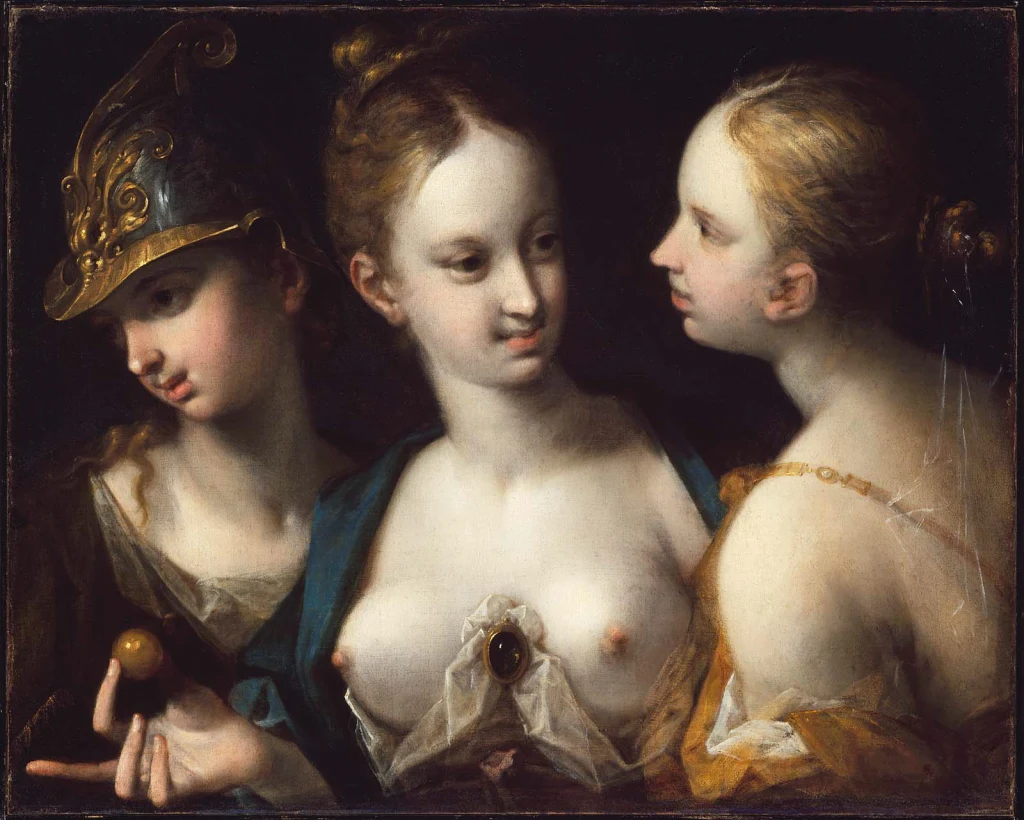
In 1592 Hans von Aachen was named court painter to Emperor Rudolf II in Prague, and this small canvas, monogrammed and dated that year or the next, was probably made for someone at that court. It shows the Judgment of Paris with Paris left out. In the myth the Trojan prince had to choose the most beautiful of three goddesses, and painters usually showed him holding out the golden apple. Here you have to recognise them by what they carry: Pallas Athena by her helmet, Juno by the crescent moon at her head, and Venus, the winner, with the apple already in her hand. The Museum of Fine Arts notes that a picture like this needed a learned viewer who could read the story without the story being told. After Prague the canvas travelled far. The museum traces it to a Moscow family in 1872, then to Vienna in 1918, New York in 1922 and Asunción in Paraguay. From 1930 it belonged to one family in Buenos Aires and Rio de Janeiro, and they sold it to Boston in 1988.