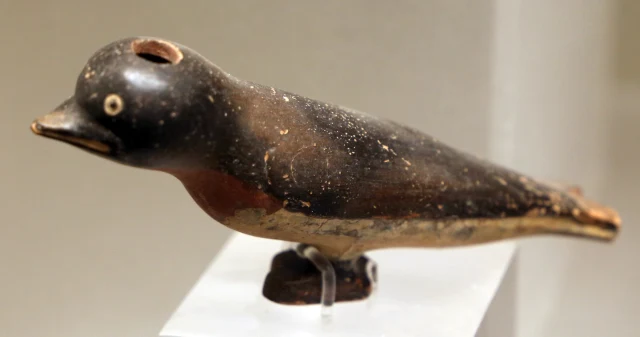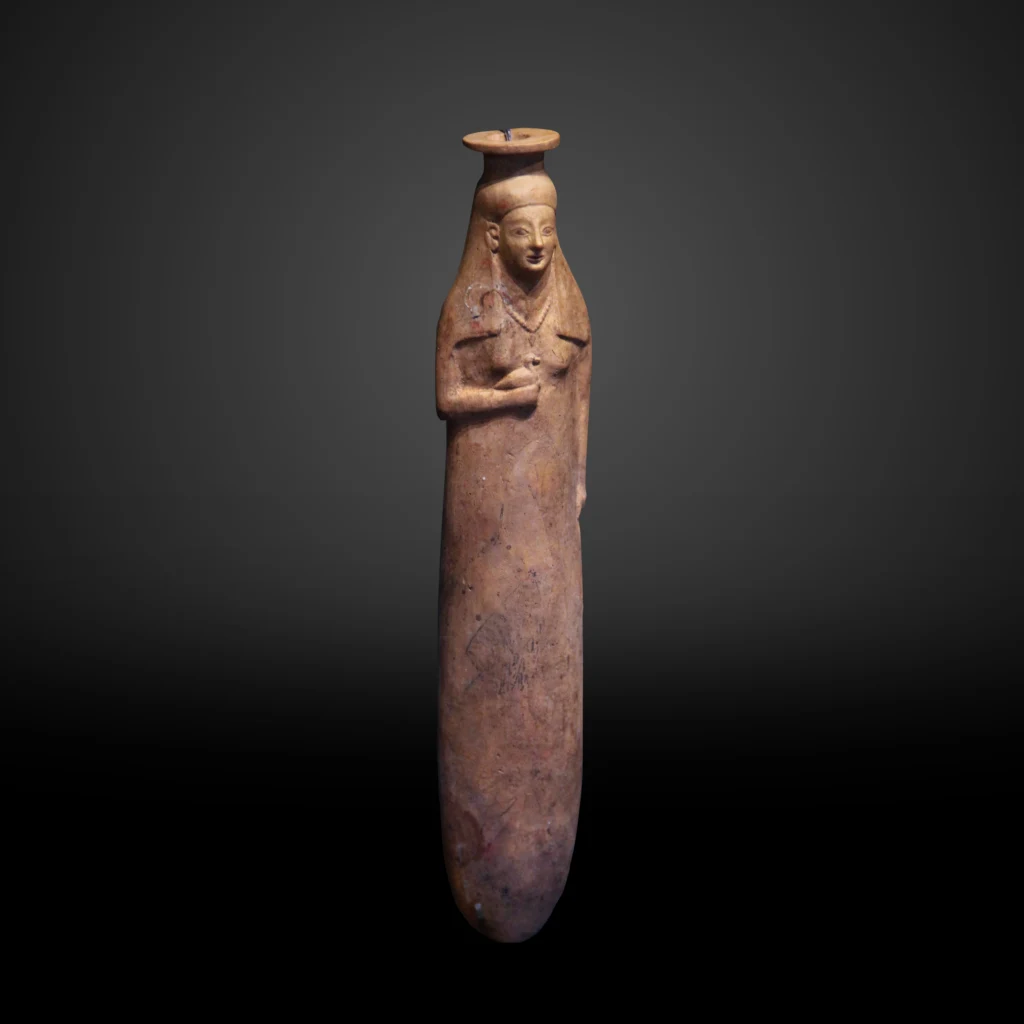
Plastic Alabastron in the Form of a Kore Holding a Bird
Details
The story
This small woman is a bottle. The flat rim on top of her veiled head is its mouth, and the whole flask, just under 16 centimetres high, was made to hold scented oil. The Greeks called such flasks alabastra, after the Egyptian alabaster from which the first of them were cut. Potters on Rhodes, around the middle of the 6th century BC, pressed figures like this one in moulds, so the same model could be turned out again and again, and then sharpened each copy by hand. Here the eyes, the ears and the necklaces were gone over with a modelling tool. She holds a bird against her chest with her right hand while the left hangs straight at her side. Traces of black and red survive on the veil, the beads and the bird's beak, and a second bird was painted on the body of the flask above a palmette.
Rhodian figure vases travelled widely, and they turn up in Etruscan tombs and in a sanctuary of Demeter at Tocra on the Libyan coast. Where this one was found is not recorded. It belonged to the Marquis Campana in Rome and reached the Louvre after France bought his collection in 1861.