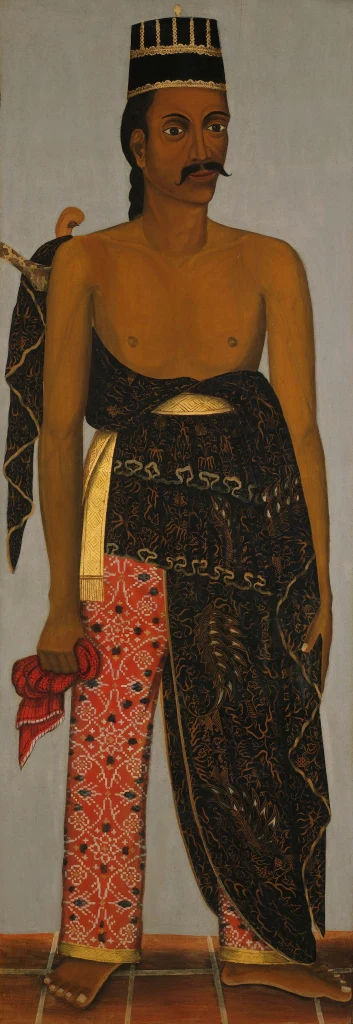
Portrait of a Javanese Regent (Bupati)
Details
The story
In the 19th century the Dutch colonial government ruled much of Java through the Javanese aristocracy, and the most senior of these officials in each regency was the bupati, or regent. In the first half of the century this elite was used more and more to control the colony and exploit it. As the Rijksmuseum puts it, knowing how its members dressed and behaved was of great political importance to the colonial administration. This full-length figure belongs to a series of five Javanese court officials, painted in oil on paper between about 1820 and 1870. He stands bare-chested, a kris tucked in at his back, a dark batik cloth wrapped over red patterned trousers and a rolled red cloth in his hand. The batik patterns were accurate enough to signal where a man came from and what rank he held.