Gustav Klimt · PD
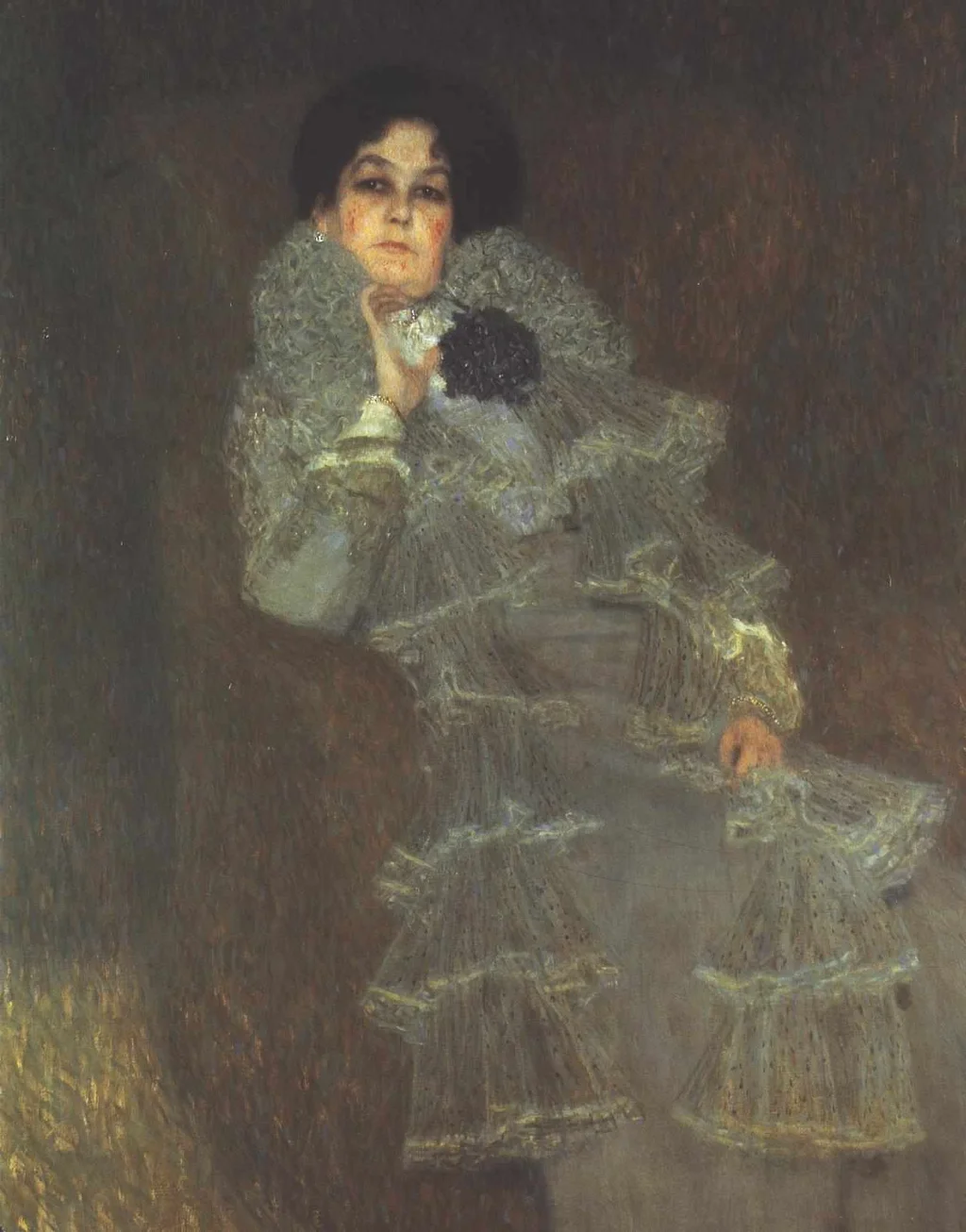
Portrait of Marie Henneberg
Details
The story
Between 1900 and 1902 a small colony of artists' houses went up on the Hohe Warte, a hill on the northern edge of Vienna, all designed by the architect Josef Hoffmann, inside and out, as single works of art. One of them was built for Hugo Henneberg, a physicist by training who had become one of the pioneers of art photography, and for his wife Marie. Klimt painted her for the new house. The portrait was first shown at the Vienna Secession in 1902, hung near Hugo's own photographs, and then went into the villa's entrance hall, above a fireplace of veined marble, iron and gilded brass. Klimt concentrated on her face and hands and let the chair and the background melt into one field of colour. The rest is the language of her position, a costly ruffled dress, two bracelets, earrings, a brooch and a spray of violets pinned to her. In the 1920s Marie sold the painting to Max Kuhn, a lawyer and publisher in Leipzig. His family lent it to the Moritzburg in Halle in 1966, and the museum acquired it in 1979.