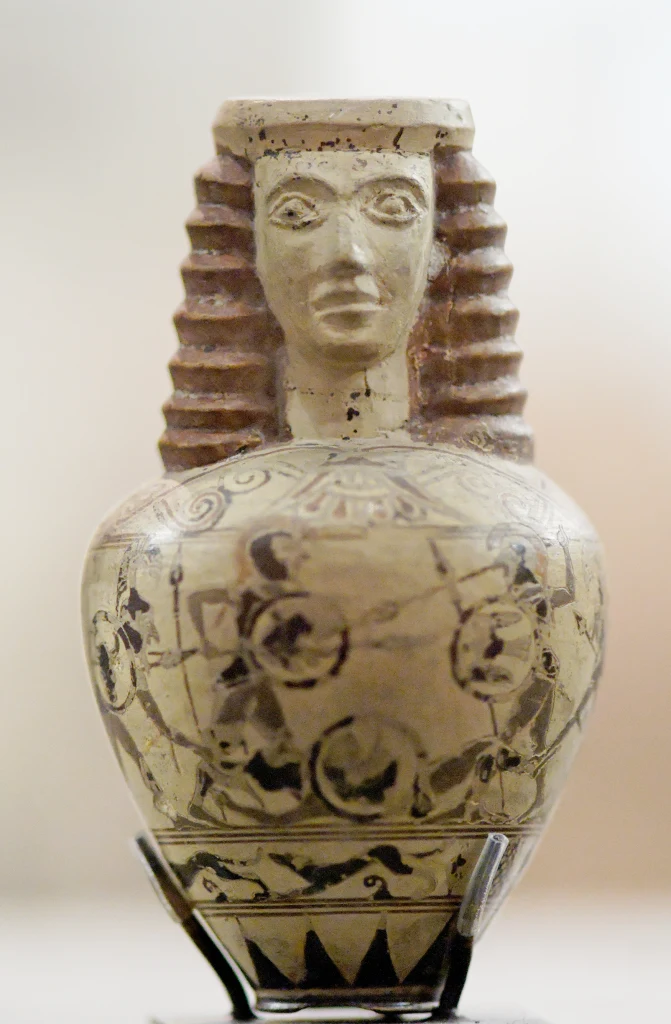
Protocorinthian Plastic Aryballos with a Woman's Head and a Hoplite Battle
Details
The story
This perfume flask is just over seven centimetres tall, small enough to close a hand around, and its neck is a woman's head. The head was pressed in a mould, with the stacked, layered wig that archaeologists call Daedalic, after Daedalus, the legendary first sculptor of the Greeks. Below it, on a body about four centimetres across, the painter fitted an entire battle. Four bearded hoplites, the heavily armed citizen soldiers of the Greek cities, fight with spears over a wounded fifth lying on the ground, their shields marked with a bird, a lion's head and a bull's head. Under them hounds chase a hare towards a net.
Corinth sent little flasks like this all over the Greek world around the middle of the 7th century BC, and this one was found at Thebes. Who painted it is an open question. The Louvre's record names three candidates, the Painter of the Berlin Centauromachy, the Boston Painter and the Chigi Group, and does not choose between them. The last takes its name from the Chigi jug in Rome, one of the best-known early pictures of hoplites in battle.