Saint Agnes
Details
The story
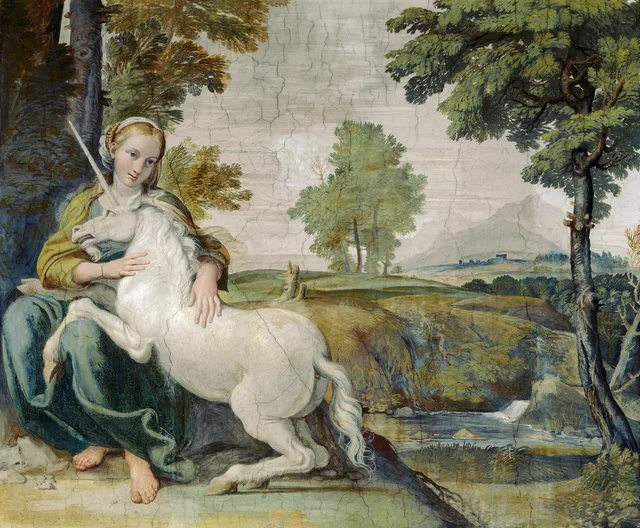
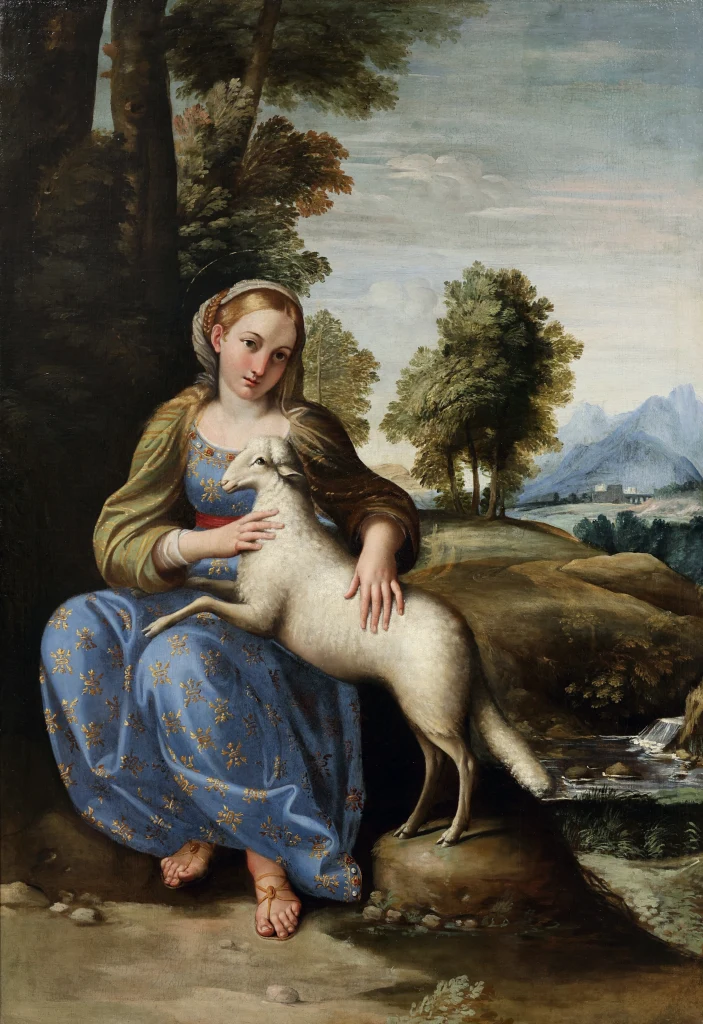
Over the entrance to the gallery that Annibale Carracci and his workshop painted in the Palazzo Farnese in Rome, a young woman sits beside a white unicorn. Two 17th-century biographers of artists, Giovan Pietro Bellori and Carlo Cesare Malvasia, wrote that the young Domenichino painted that fresco from a cartoon by Annibale himself, a full-size preparatory drawing. Many modern scholars doubted the story and gave the fresco to other hands in the Carracci circle. This Saint Agnes brought the cartoon back into the argument. When a tracing of the fresco's outlines was laid over this canvas, the profiles and proportions matched exactly. The same drawing served twice, once on the wall and once here, and the lady with the unicorn became a saint. The museum dates the picture between 1606 and 1610. In July 1661 Cardinal Flavio Chigi, nephew of Pope Alexander VII, bought it for 50 scudi, a respectable price, from a Florentine banker in Rome, as a Domenichino "with its landscape". The Italian state acquired the Chigi collection in 1918, and the saint then spent almost a century on the walls of Palazzo Chigi, the seat of the Italian government, before coming to the museum in 2017.