Saint George and the Dragon
Details
The story
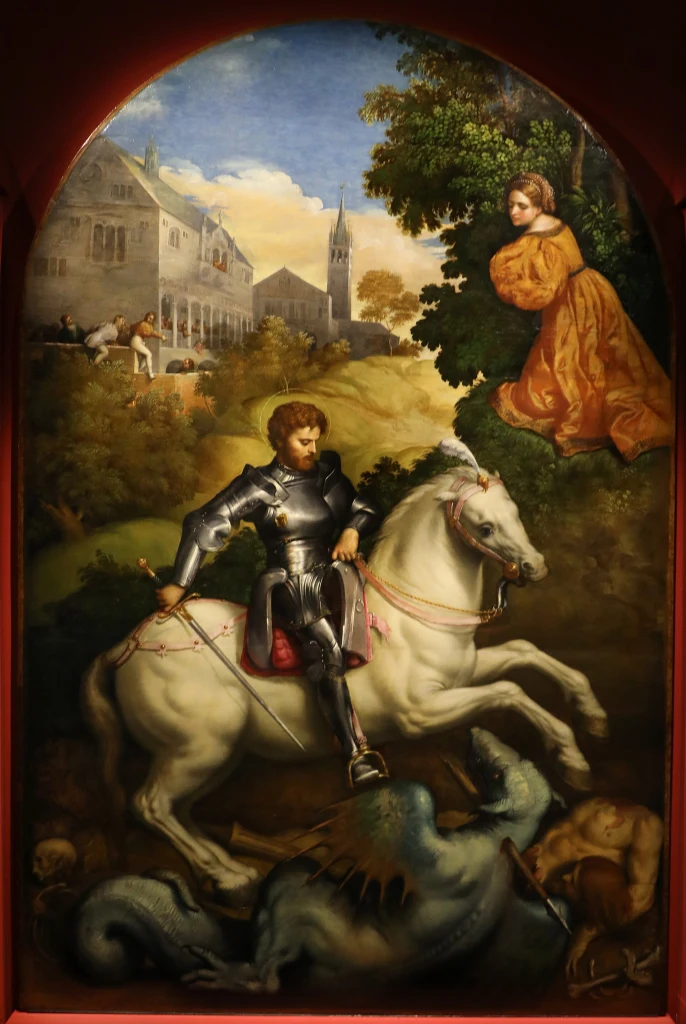
Around 1525 the Franciscan friars of San Giorgio at Noale, a small walled town on the Venetian mainland near Treviso, set this panel over the altar of their church, and the dragon-slayer it shows was the saint their church was named for. It is almost three metres tall, built from eight poplar boards. When the Vatican's restorers examined it before the cleaning finished in 2022, they found that Paris Bordone had changed his mind as he worked, above all about the horse's head, its position and its trappings.
The picture stayed on that altar until 1769. It then passed to a Venetian family, the Bembo Dardi, was recorded at the Quirinal palace in Rome in 1787, and two years later the papal government bought it for the picture gallery Pius VI was forming. Names did not always travel with it. One old photograph, taken when it hung in an antechamber of the papal apartments, captions it as the work of Pordenone, a painter from Friuli.
After the restoration it went north for a few months in 2022, to an exhibition of Bordone's work in Treviso, his home town, before coming back to Room X.