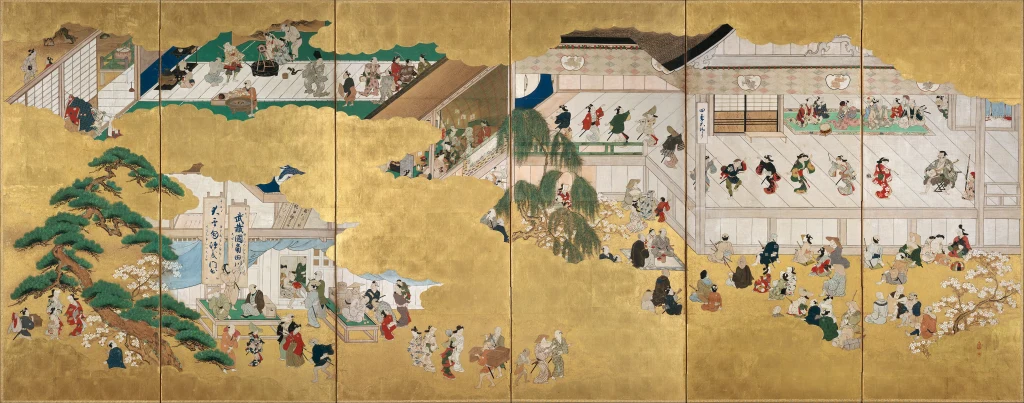
Scenes from the Nakamura Kabuki Theater
Details
The story
In the Edo of the 1680s, the city now called Tokyo, the shogun's government licensed only a handful of kabuki theatres, and the Nakamura-za was the oldest of them. Nakamura Kanzaburō had opened it in 1624, and since 1651 it had stood in Sakai-chō, a quarter of theatres, puppet stages and teahouses. A drum tower over the entrance marked the official licence. Women had been banned from the kabuki stage in 1629 and boy actors in 1652, so by now every role, the women's included, was played by grown men.
This is one of a pair of six-panel folding screens on gold leaf, and gold clouds cut the scene into separate views. At the right the stage stands under its own roof, with performers on the boards and spectators sitting on the open ground before it. Further left, crowds move along the street beneath tall signboards. The companion screen, also in Boston, turns to the Yoshiwara, Edo's licensed pleasure quarter and the city's other great place of entertainment. The museum dates the pair broadly to the Jōkyō and Genroku eras, the years between 1684 and 1704.