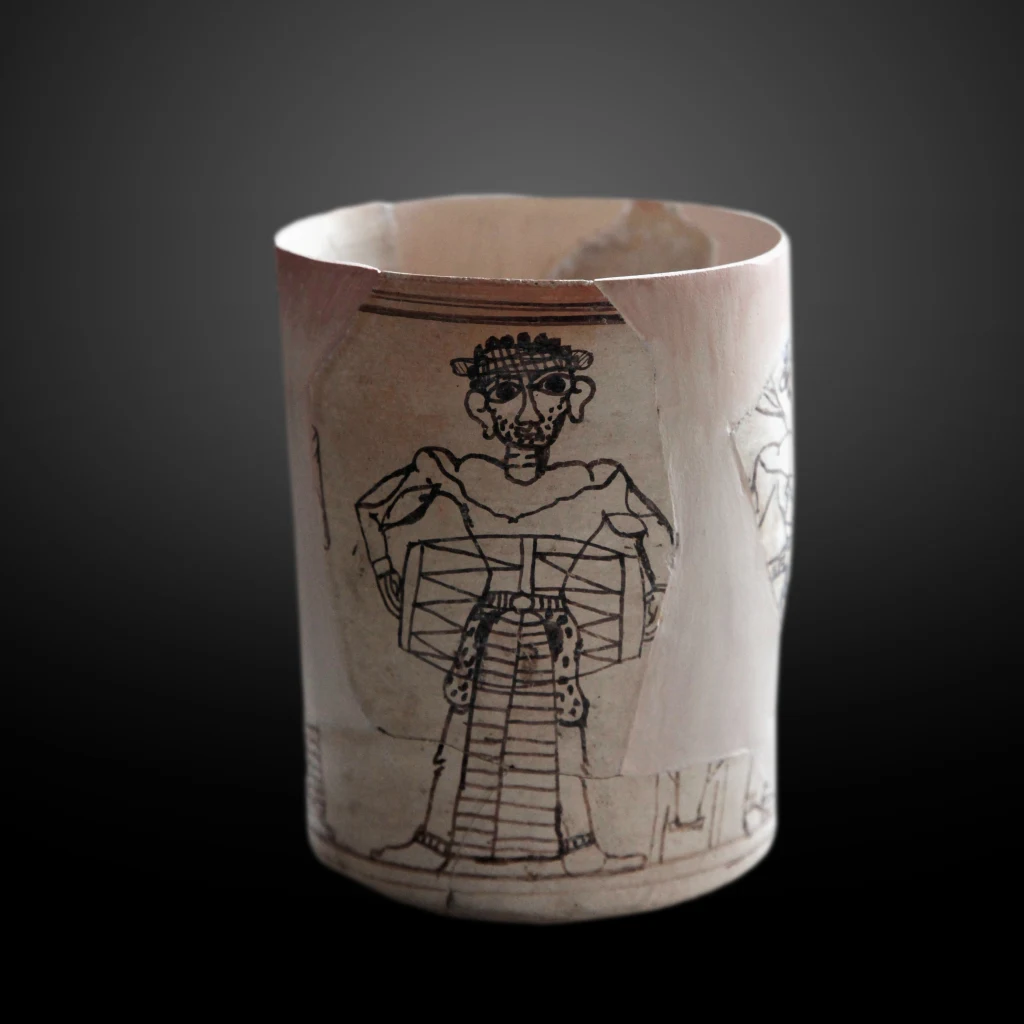
Straight-Sided Beaker with a Drummer
Details
The story
This beaker is under 12 centimetres tall, and its walls are about two millimetres thick. It was made in the kingdom of Kush, whose capital, Meroë, stood on the Nile north of present-day Khartoum, in Sudan. The Louvre places it in the Classic Meroitic period, between about 100 BC and AD 100, though specialists have argued for dates later still. Painted in thin brown-red line, a bearded man faces us head-on, a band round his hair, holding what looks like a barrel drum across his body. The museum's own description marks the drum, the music and the dancing around him each with a question mark.
The cup came to Paris in pieces. The British archaeologist John Garstang dug at Meroë in the years before the First World War, and in 1913 the Louvre bought this broken beaker from him, perhaps from one of the city's tombs. 80 years later a sherd that belonged to it turned up on the market, and in 1993 the museum bought it from Julia Schottlander and fitted it back in. The plain patches on the surface are the parts that are still missing.