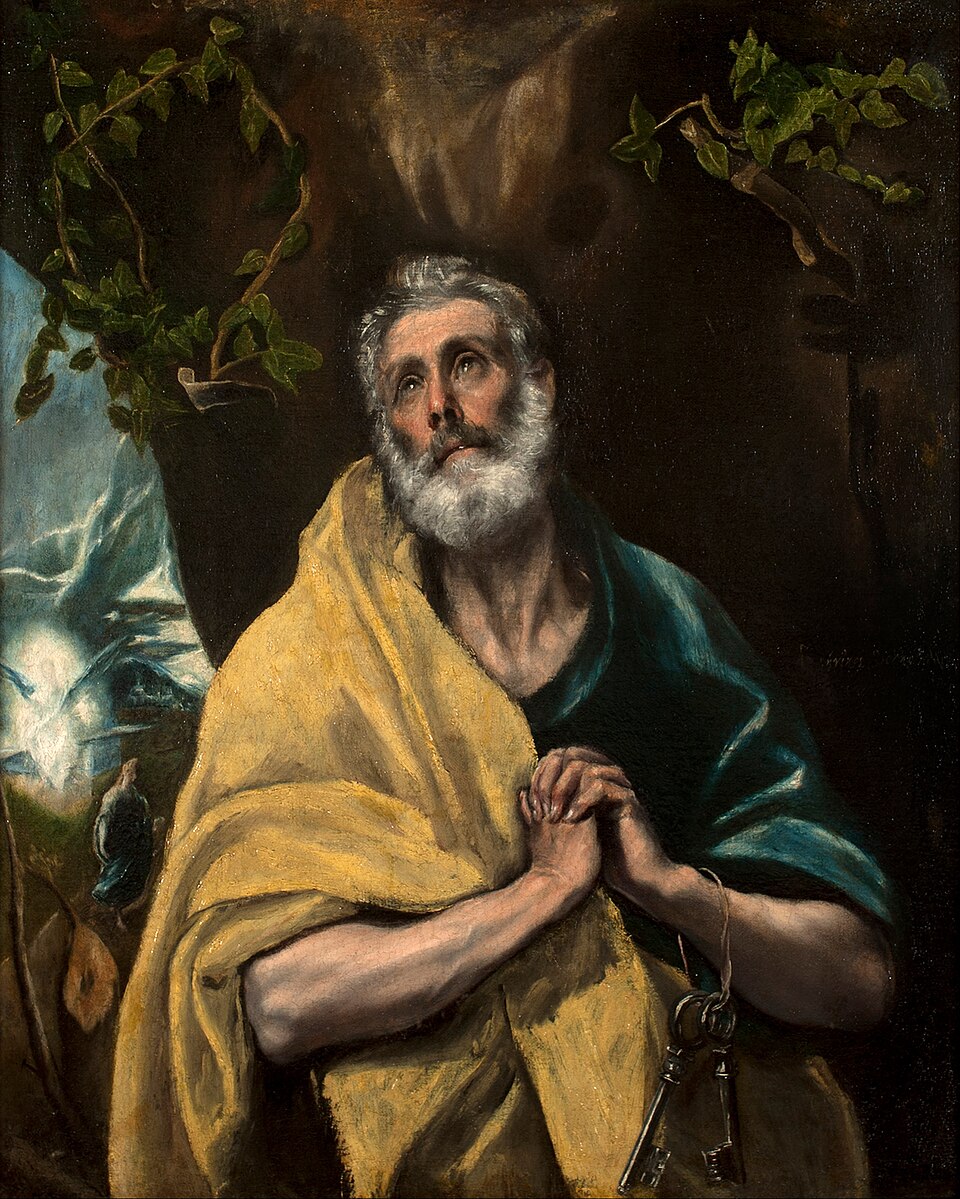
El Greco, Tears of Saint Peter, 1592. Wikimedia Commons. · PD
Tears of Saint Peter
Details
The story
The Catholic church at the end of the 16th century was pressing hard on confession. The Council of Trent had closed in 1563 reaffirming penance as a sacrament, and devotional writers urged sinners to feel their guilt and weep over it. Peter, who denied knowing Christ three times and then went out and wept, became the model case, helped along by a long Italian poem on his tears by Luigi Tansillo that circulated widely in Spain. El Greco appears to have been the first painter to show him alone, half-length and close to the viewer, eyes wet and turned upward. He and his Toledo workshop repeated the composition many times over the years that followed. The canvas in the El Greco Museum is signed at the height of Peter's shoulder, and the museum dates it between 1587 and 1596. Which of the surviving versions came from his own hand is still argued over. Harold Wethey, who compiled the standard catalogue of his work, called this one the best the studio produced, while Spanish scholars have kept it under the painter's own name.