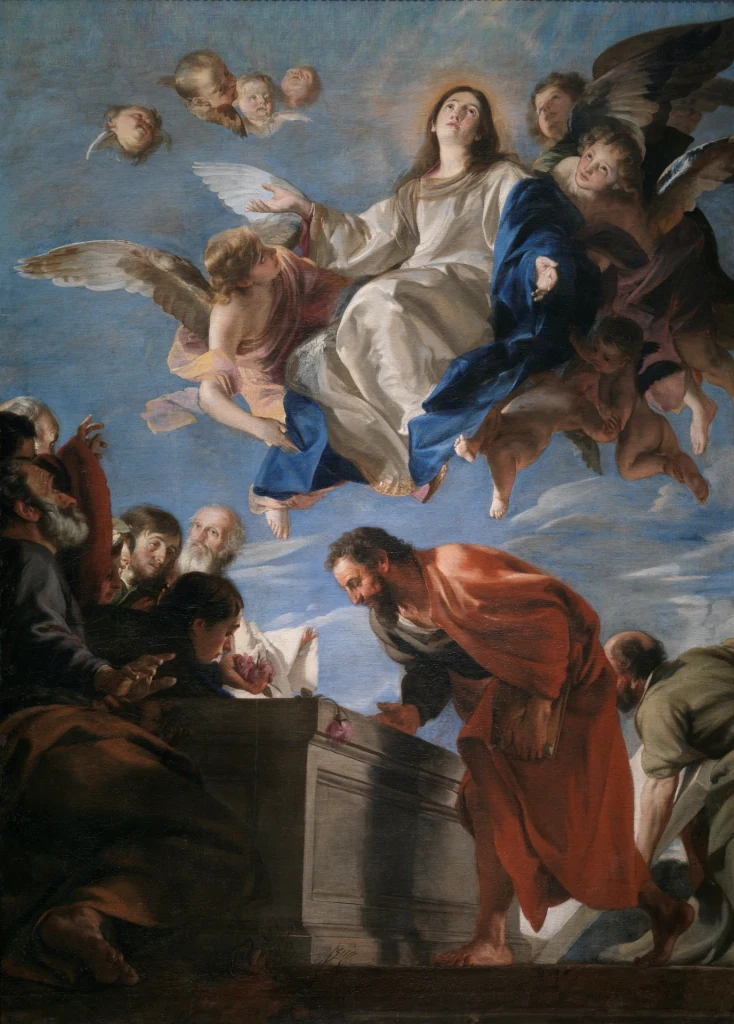
The Assumption of the Virgin
Details
The story
The Prado puts this canvas at about 1665. Philip IV had just died in Madrid, the crown had gone to a boy of four under his mother's regency, and the city's churches went on ordering pictures at the same rate as before.
The subject is the Assumption, the Catholic teaching that the Virgin was taken up into heaven in body as well as soul. Angels carry her up through the light across the top of the canvas. Below, the apostles are gathered around the tomb they have found empty, and their reactions fill the lower half.
For a long time the picture hung under another man's name, that of Mateo Cerezo, a Castilian painter of the same generation. In 1959 the historian Martin Soria connected it instead with the canvases Cabezalero is documented as painting for a Madrid confraternity, the Venerable Orden Tercera, in 1667 and 1668. Very little else is securely his.
The bright, strong colour and the way the composition opens upward show he had studied Rubens, as most Madrid painters of his generation had. The royal collection was full of Flemish canvases, and it was out of that same collection that this Assumption came into the Prado in 1829.