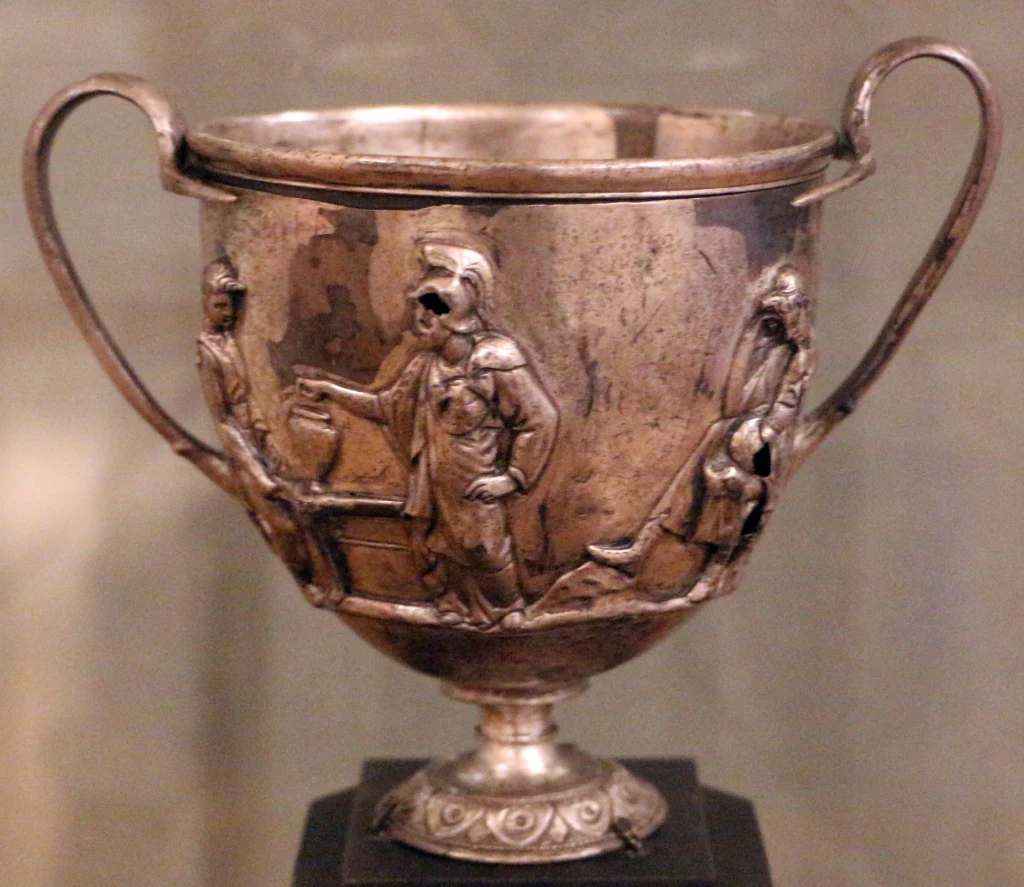
The Corsini Cup
Details
The story
In 1759 a small silver cup was found near the harbour of Anzio, on the coast south of Rome. That same year Thomas Jenkins, an English painter and dealer living in Rome, drew it and sent the drawing to the Society of Antiquaries in London. His note says fishermen pulled it up in their nets at sea off Nettuno, next to Anzio, and that it already belonged to Cardinal Corsini. Jenkins also explained how it was made. The figures were hammered up from the silver and finished with a chisel, and a separate smooth cup sits inside to hide the rough back of the relief, held by the springy handles so that it can be lifted out.
The relief shows the end of the story of Orestes as the Athenian playwright Aeschylus told it. Orestes has killed his mother Clytemnestra, who with her lover had murdered his father Agamemnon, and the Furies have hounded him ever since. A court in Athens tries him, and the goddess Athena casts the vote that sets him free. The Roman writer Pliny the Elder mentions two cups by a Greek silversmith called Zopyros with exactly this trial, valued at 1,200,000 sesterces, at a time when a legionary was paid about 900 a year. The museum thinks this cup is very probably one of the two.