The Crucifixion
Details
The story
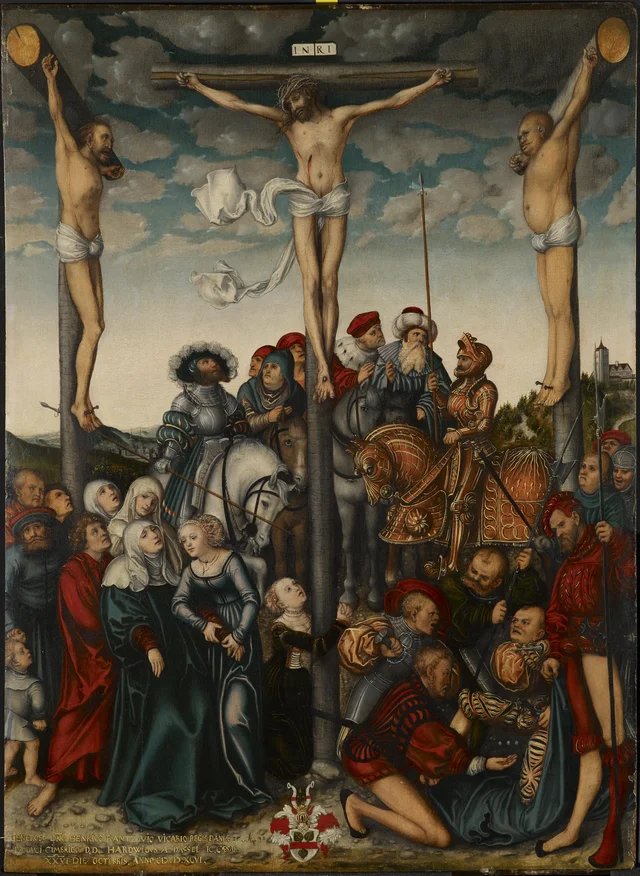
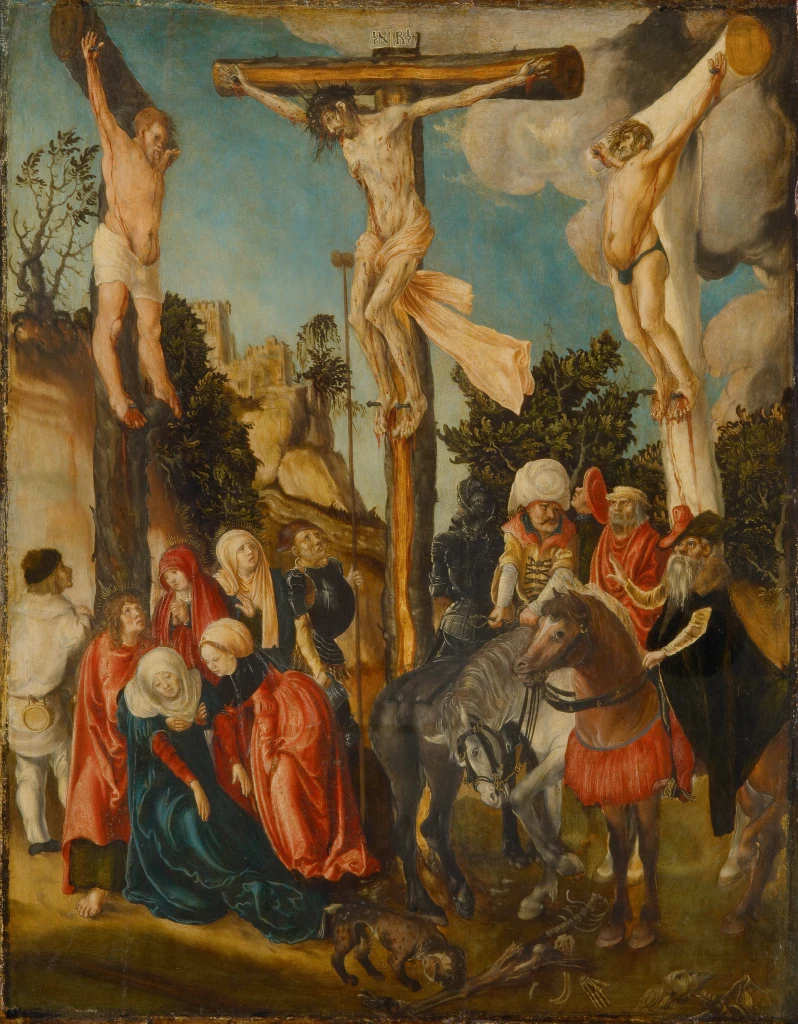
For generations this small panel belonged to the Schottenstift, the old Benedictine abbey in the centre of Vienna, where it was catalogued as the work of Lucas van Leyden, a Dutch painter a generation younger. In 1904 the art historian Friedrich Dörnhöffer gave it to a different Lucas, Cranach, and placed it around 1500. It is now taken as the earliest painting of his that survives. Almost nothing is documented about Cranach before his first dated works appear in Vienna in 1502, so this picture is one of the few witnesses to those years, and it raises a question of its own. Some of the men at the foot of the cross wear clothes that scholars read as Slavic, and one of the riders has a large white turban. That has kept alive the idea that he worked in Krakow or Buda before Vienna, though the evidence has never settled it. The underdrawing is free and sketchy, a working drawing by the painter himself rather than a copy after someone else's design. Look at the faces of the women on the left. Their tears are painted as fine blue lines running down their cheeks.