The Donation of Constantine
Details
The story
More than 80 years before this wall was painted, the humanist Lorenzo Valla had shown that the Donation of Constantine was a forgery. The document claimed that the emperor, in gratitude to Pope Sylvester, had handed the popes Rome and the western half of his empire. Valla, writing in 1440 in the service of Alfonso of Aragon, took its Latin apart and found words and titles no Roman of Constantine's day would have used. The first printed edition of his treatise came from the German humanist Ulrich von Hutten, with a mocking preface addressed to Leo X, and in 1520 Martin Luther read it.
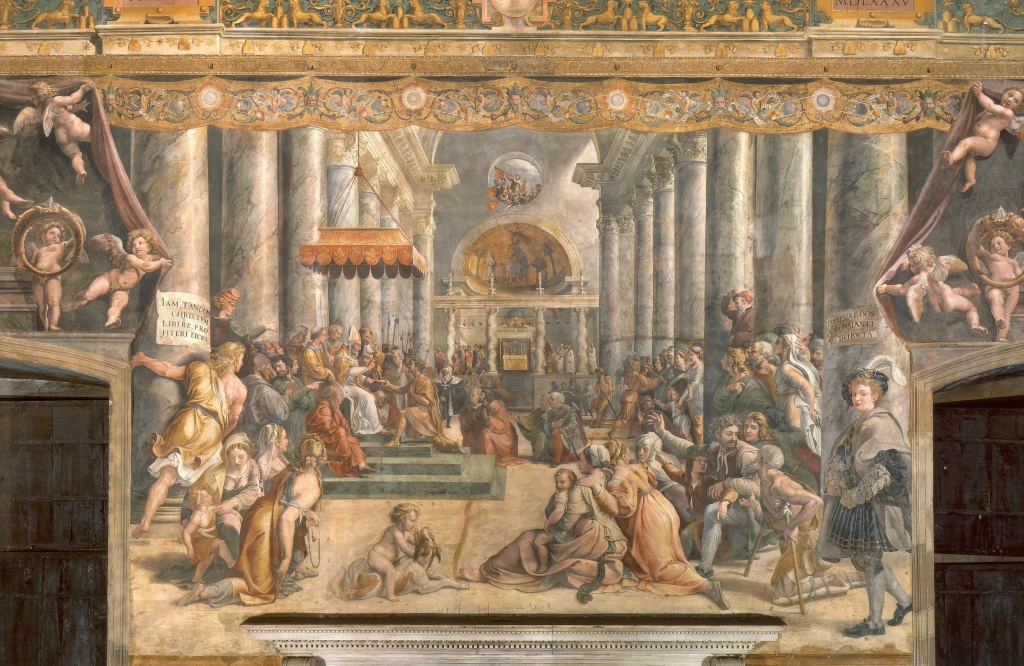
The Medici popes had the story painted anyway, as the closing scene of the hall, in about 1523 and 1524. Constantine kneels before Sylvester, who has the features of Clement VII, and hands him a small golden statue standing for the city of Rome. The Vatican credits the figures to Gianfrancesco Penni, while 19th-century scholars gave the execution to Giulio Romano.
The setting preserves a building that has since disappeared. It is the interior of the old basilica of Saint Peter, with its long columned nave, the mosaics of the apse and the twisted columns around the apostle's tomb, still standing when this was painted and pulled down in the early 17th century.