The Fortune Teller
Details
The story
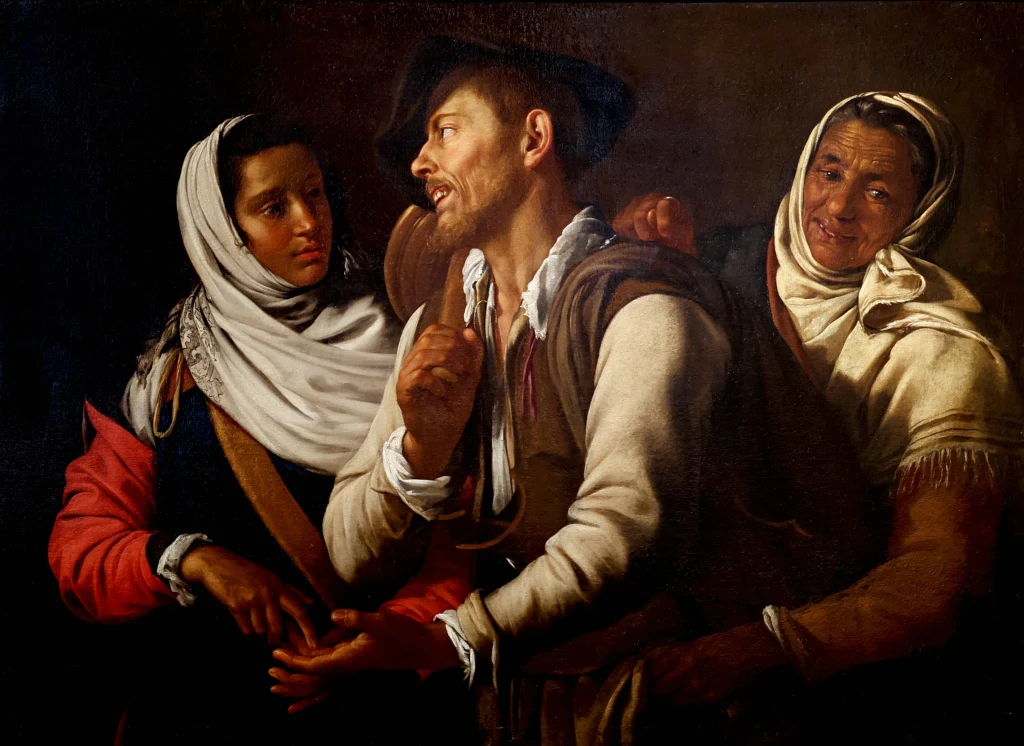
For most of its life this canvas went under other names. The Torlonia family catalogued it as a Caravaggio in 1855 and again in 1892, a scholar in 1955 thought of Bartolomeo Manfredi, and for decades it was treated as a copy of a very similar picture in Florence, a pair to which Manfredi, Antiveduto Gramatica and even Mattia Preti were proposed in turn. Then, during a restoration in 1996, a Latin inscription in large capitals turned up on the back of the original canvas. It describes the woman as an Egyptian, commonly called a gypsy, telling the fortune of a foolish cobbler, painted from life by Simon Vouet, and it gives the year 1617. That makes it the earliest documented picture by the young Frenchman, then a few years into his time in Rome. The lettering matches the inscriptions on paintings by Poussin that belonged to the scholar and collector Cassiano dal Pozzo, and a dal Pozzo inventory of 1729 lists two gypsies telling a peasant's fortune by Monsù Bovett, the way a Roman clerk wrote Monsieur Vouet. The scene borrows from Caravaggio's fortune teller, now on the Capitoline, and sharpens the joke. The young man only has eyes for the pretty palm reader, while the old woman behind him makes the fig, a rude sign with the thumb pushed between two fingers, a hint that his purse is about to go. The inscription can no longer be seen, because the canvas has been lined again.