The Large Horse
Details
The story
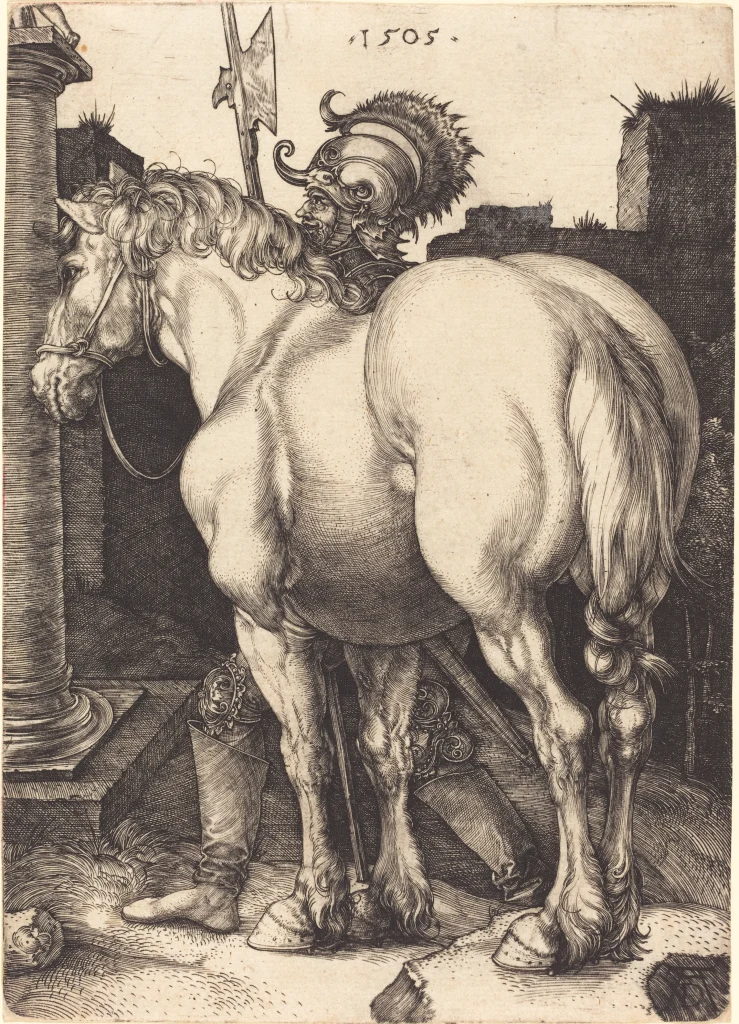
Dürer engraved this plate in 1505 as the opposite of its companion, The Small Horse. The small horse is shown side-on, light and restless. This one is seen from behind, a heavy, calm animal planted with its hind hooves up on a raised step, while a soldier holding a halberd, the long axe-headed pole of the foot soldiers of the day, stands beside it. Dürer foreshortened the body to roughly half its real length, so the great rump and haunches fill the plate. Specialists point out that, unlike his studies of the ideal horse, this one was not built up on a grid of measurements. It was drawn as a living mass, and the raised ground and the flat wall behind it make it look bigger still. Possible models have been traced to a horse drawn by the Italian Pisanello and to a page in the sketchbook of the Venetian painter Jacopo Bellini, both from the generation before Dürer. The Boston sheet is one impression from the copper plate, of the many that were printed. It came with the print collection of the New York collector Henry Foster Sewall, which he offered to the museum in 1888 and which the museum finally bought in 1897, a year after his death.