The Last Judgment
Details
The story
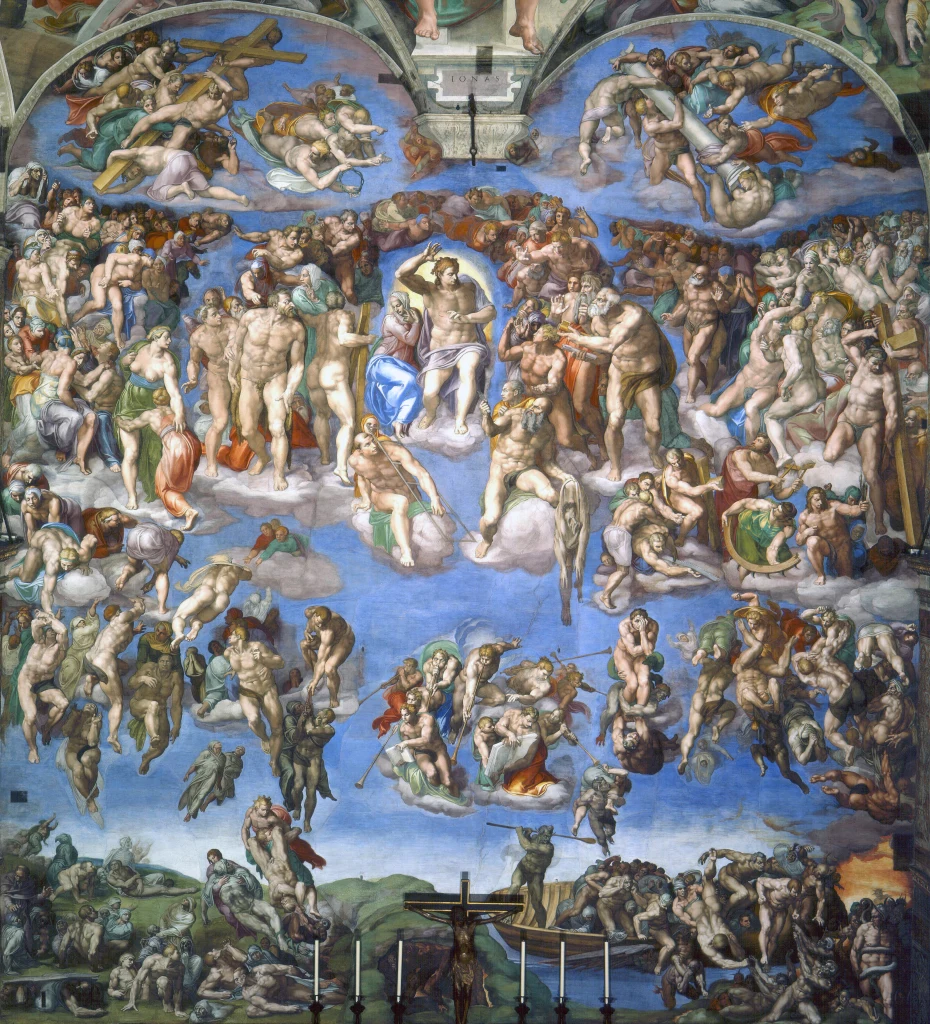
Before Michelangelo could start the Last Judgment, the altar wall of the Sistine Chapel had to be cleared. Pope Clement VII first proposed the commission in the early 1530s, his successor Paul III confirmed it, and the painting itself ran from 1536 to 1541. What was already on the wall was sacrificed. Perugino's fresco of the Assumption of the Virgin, painted for the chapel's original altar, was destroyed. Two windows were filled in. So were two of the lunettes of Christ's ancestors that Michelangelo himself had painted about 25 years earlier.
What replaced them was a wall of naked bodies rising and falling around Christ, and not everyone at the papal court approved. The pope's master of ceremonies, Biagio da Cesena, complained that so many nudes had no place in so honoured a chapel. According to the biographer Giorgio Vasari, Michelangelo answered by giving Biagio's face to Minos, the judge of the underworld, down in the bottom right corner, with donkey's ears and a snake wound around his body. Biagio's objection outlived him. After the Council of Trent tightened the rules for sacred images, the painter Daniele da Volterra was set, after 1564, to paint drapery over the most exposed figures, and Romans nicknamed him il Braghettone, the breeches-maker. The restoration completed in 1994 removed many later cover-ups but kept his, as part of the fresco's own history. Just below Christ, Saint Bartholomew holds up the skin flayed from him in his martyrdom, and the sagging face on it is usually recognised as Michelangelo's own.