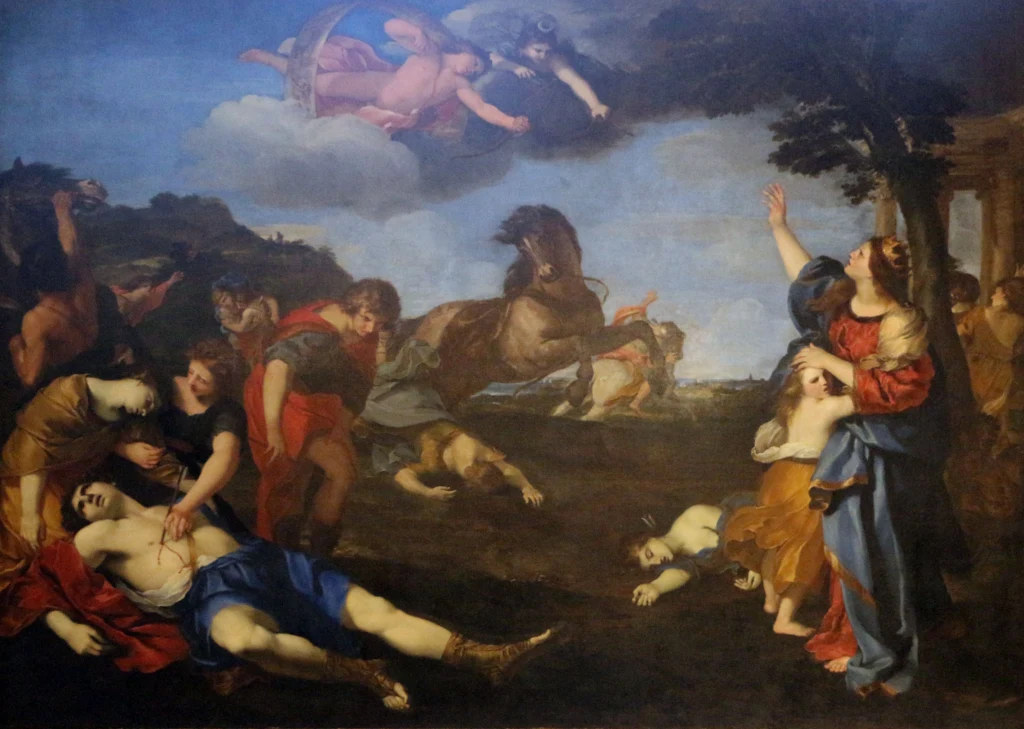
The Massacre of the Niobids
Details
The story
On 25 September 1630 Andrea Camassei was paid for "the history of Queen Niobe". That payment, published in 2020, moved this huge canvas, three metres by four, about nine years earlier than scholars had thought. It had always been treated as the companion of his Rest of Diana, a picture of the same size finished early in 1639, and both were painted for Taddeo Barberini, nephew of Pope Urban VIII and Camassei's protector.
The story is Ovid's. Niobe, queen of Thebes, boasted of her many children before Latona, who had only two, Apollo and Diana, and the twins shot Niobe's sons and daughters down with arrows. Ovid tells the two killings one after the other. Camassei puts them into a single scene, with the gods arriving on clouds, a young man near the centre trying to pull an arrow from his knee, and Niobe shielding her youngest daughter with a fold of her dress.
The new date matters. In 1630 plague was spreading through northern Italy, and writers from Homer onward had linked the arrows of Apollo with epidemic disease. A reading published in 2023, which the museum finds the more likely one, sees here an allusion to the epidemic that Rome escaped after Urban VIII quickly set up a health board. The dying youth on the left, struck in the chest and tended by his sisters, recalls Saint Sebastian nursed by pious women, the saint invoked against plague.