The School of Athens
Details
The story
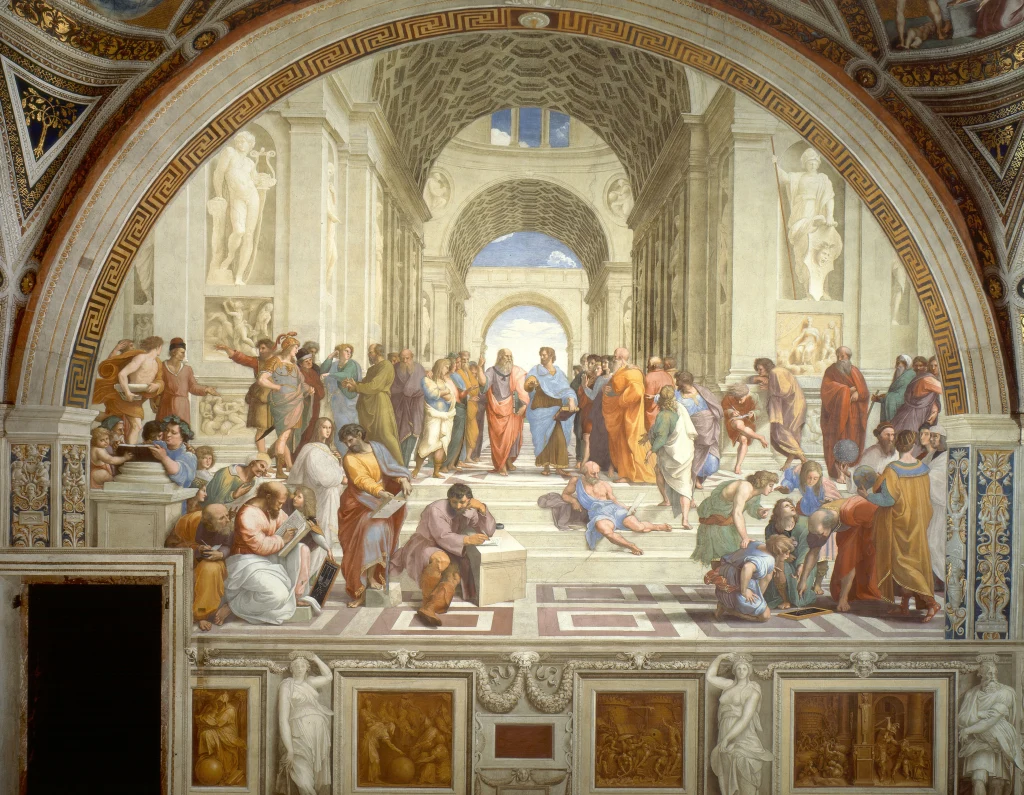
The name on this fresco is not Raphael's. He painted it between 1509 and 1511 for the pope's private apartments, and for a long time nobody agreed on what it showed. Giorgio Vasari, writing a generation later, described theologians reconciling philosophy and astrology with theology. The title School of Athens came afterwards.
Only two figures are certain, and they are identified by the books in their hands. At the centre, under the arches, the old, barefoot Plato holds his Timaeus and points upward. Aristotle walks beside him holding his Ethics, his palm turned toward the ground. Almost everyone else in the hall has been named by guesswork over the centuries. Vasari saw the architect Donato Bramante in the bald man bending over a slate with a pair of compasses, the figure usually called Euclid, and a young face at the far right edge, looking straight out at us, is traditionally taken to be Raphael himself.
Bramante was more than a model. While Raphael worked in this room, Bramante was building the new Saint Peter's a short walk away, and the great coffered vaults of the painted hall resemble his plans for the basilica then rising. In niches on either side stand two statues, Apollo with his lyre on the left and Minerva, goddess of wisdom, on the right. The full-size cartoon Raphael drew for the figures has survived, and it is kept in Milan, at the Pinacoteca Ambrosiana.