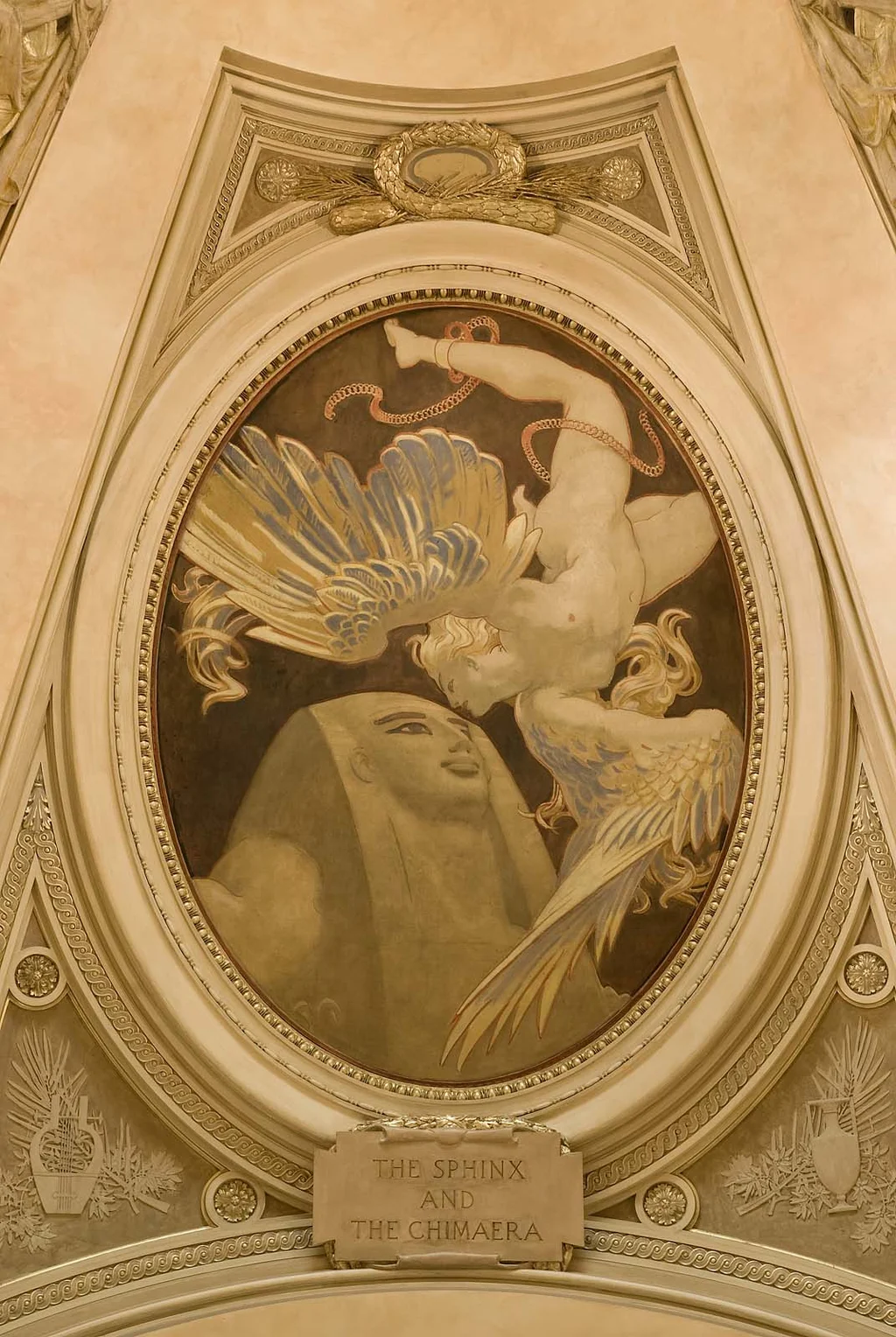
John Singer Sargent · PD
The Sphinx and the Chimaera
Details
The story
Gustave Flaubert worked on and off for a quarter of a century on The Temptation of Saint Anthony, a book in which the desert hermit is visited through one long night by gods, heretics and monsters. Near the end two of them meet in front of him. The Sphinx stands for the Unknown and says that he keeps his secret, his gaze fixed on an unreachable horizon while seas turn and cities fall. The Chimera stands for Fancy, light and joyful, offering people dazzling prospects, plans for happiness and dreams of glory. Then each speaks one line to the other. O Fancy, says the Sphinx, carry me away on your wings to lighten my sadness. O Unknown, the Chimera answers, I am in love with your eyes. According to the museum's guide of 1922, this passage gave Sargent the idea for one of the four large oval paintings in the dome. His Sphinx is a stone head on a block shaped like a pyramid, with the hood and the clawed foreleg of the Great Sphinx at Giza, its face lifted. The Chimaera hovers close above it, a woman with streaming hair and wings where her arms should be, and broken chains trail from her ankles.