The Tomb of Master André
Details
The story
In 1697 Louis XIV threw the Italian actors out of Paris, after their company announced a play said to mock his wife, Madame de Maintenon. For almost 20 years the city had no Italian troupe of its own. Only after the old king died did the regent, Philippe d'Orléans, send to Italy for new players, and they opened in Paris in May 1716.
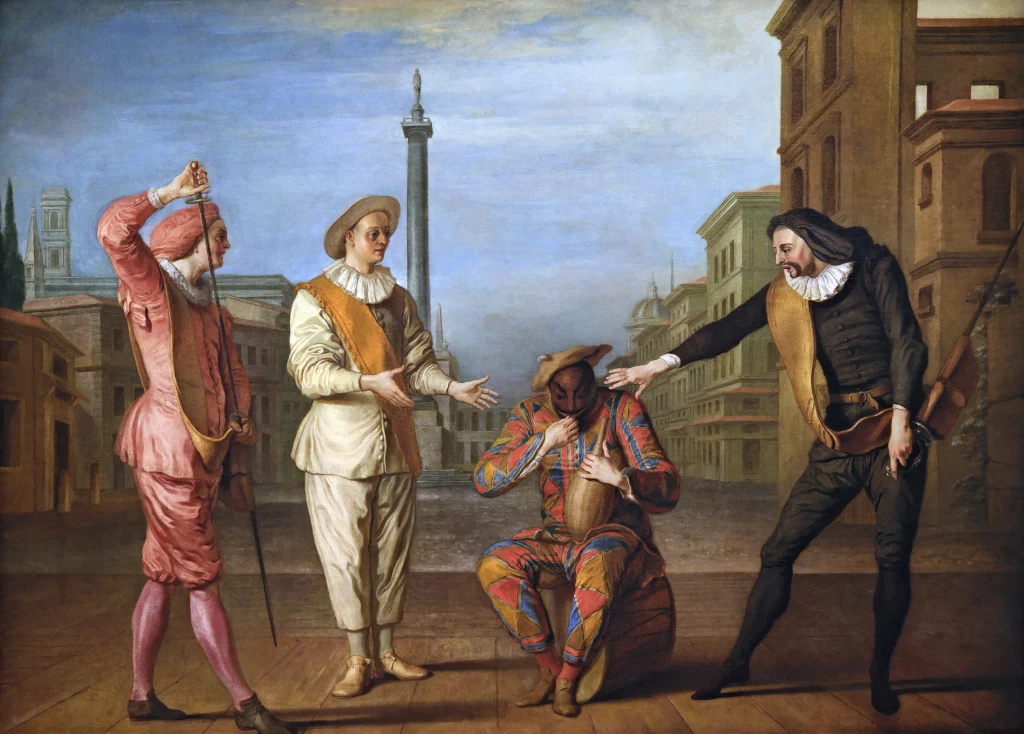
That same year a comedy from the banished company's old repertoire came back on stage, The Tomb of Master André, first played in 1695. Its plot borrowed from a fable by La Fontaine, The Oyster and the Litigants, in which two travellers quarrelling over an oyster ask a judge to settle it, and he eats it and hands each of them a shell. Gillot painted the opening two scenes around 1716 or 1717. Four figures of the Italian comedy gather in a street that looks like a stage set, with Harlequin sitting on a barrel in the middle. The Louvre bought the canvas in 1945.