The Vanity of Human Life
Details
The story
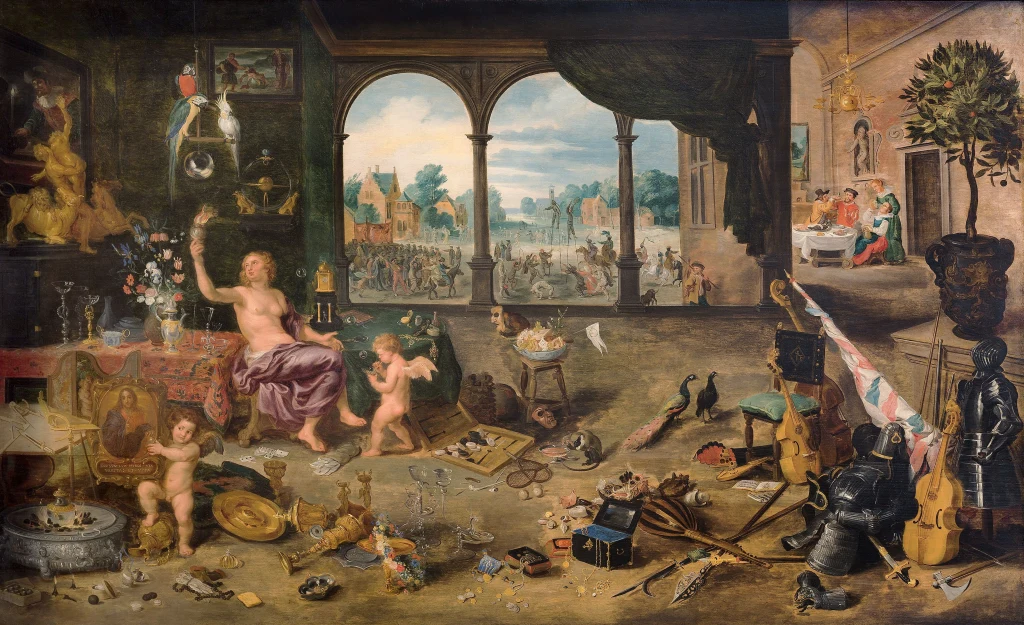
In 1631 Jan Brueghel the Younger was dean of the painters' guild in Antwerp, and for three years his workshop had been sending regular shipments of pictures to his cousin Chrysostoom van Immerseel, who ran a large trading house in Seville. That year Jan offered Immerseel a painting of this subject made by his late father, Jan Brueghel the Elder, together with Rubens. The sale came to nothing. Jan then painted two copies of the composition himself, and the Galleria Sabauda thinks this panel may be one of them. It was probably bought by Duke Victor Amadeus I of Savoy, and it was in Turin by 1635.
The room is crowded with reminders that earthly things pass, jewels, books, musical instruments and board games, under an open loggia of three arches. In front, a cupid holds up an image of Christ. Just behind him a woman, read either as Psyche or as an allegory of Painting, raises a lit torch while another child blows soap bubbles, and a clock marks the passing time.