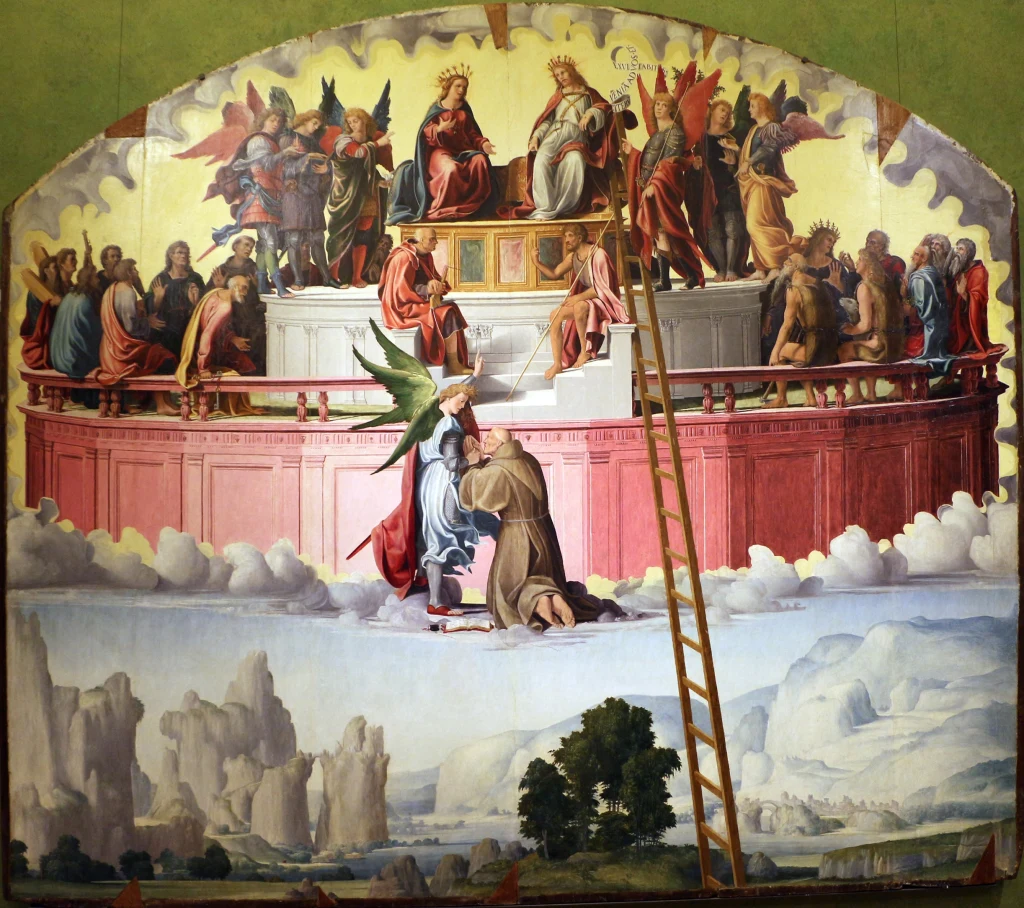
The Vision of the Blessed Amadeus Menez de Sylva
Details
The story
In the early 1500s prophecies of a coming angelic pope, who would reform the Church, circulated in Rome, and one of them came from the Janiculum hill. Its author was Amadeus Menez de Sylva, a Portuguese nobleman turned Franciscan friar, confessor to Pope Sixtus IV, who died in 1482. His followers, the Amadeites, kept a stricter rule than the rest of the order, and their main house was San Pietro in Montorio, the church on the Janiculum rebuilt with money from the Spanish monarchs Ferdinand and Isabella. Amadeus had his visions written down and sealed, for the eyes of a future pope alone. The seals were broken in secret at San Pietro in Montorio on the orders of the Spanish cardinal Bernardino de Carvajal, and the text, known as the Apocalypsis Nova, the new revelation, spread quickly.
Pedro Fernández, a painter from Murcia then working in Rome, turned its first vision into this panel around 1513 or 1514, a picture almost three metres tall and wider still. The archangel Gabriel shows the kneeling old friar the court of heaven. Christ and the Virgin sit on the highest step, she framed by a seven-pointed diadem, with seven angels around them. Below are figures of the Old Testament on the right and of the New on the left, with Saint Joseph and John the Baptist between the two groups, and the book itself lies at the friar's feet. The museum points to the number seven, which keeps returning, and to the ladder, a means of rising toward God, as signs of the mystical and cabbalistic interests of those years. The panel came from the hermitage of San Michele Arcangelo in the Sabina, and the wide landscape may be that countryside.