Gustave Courbet · PD
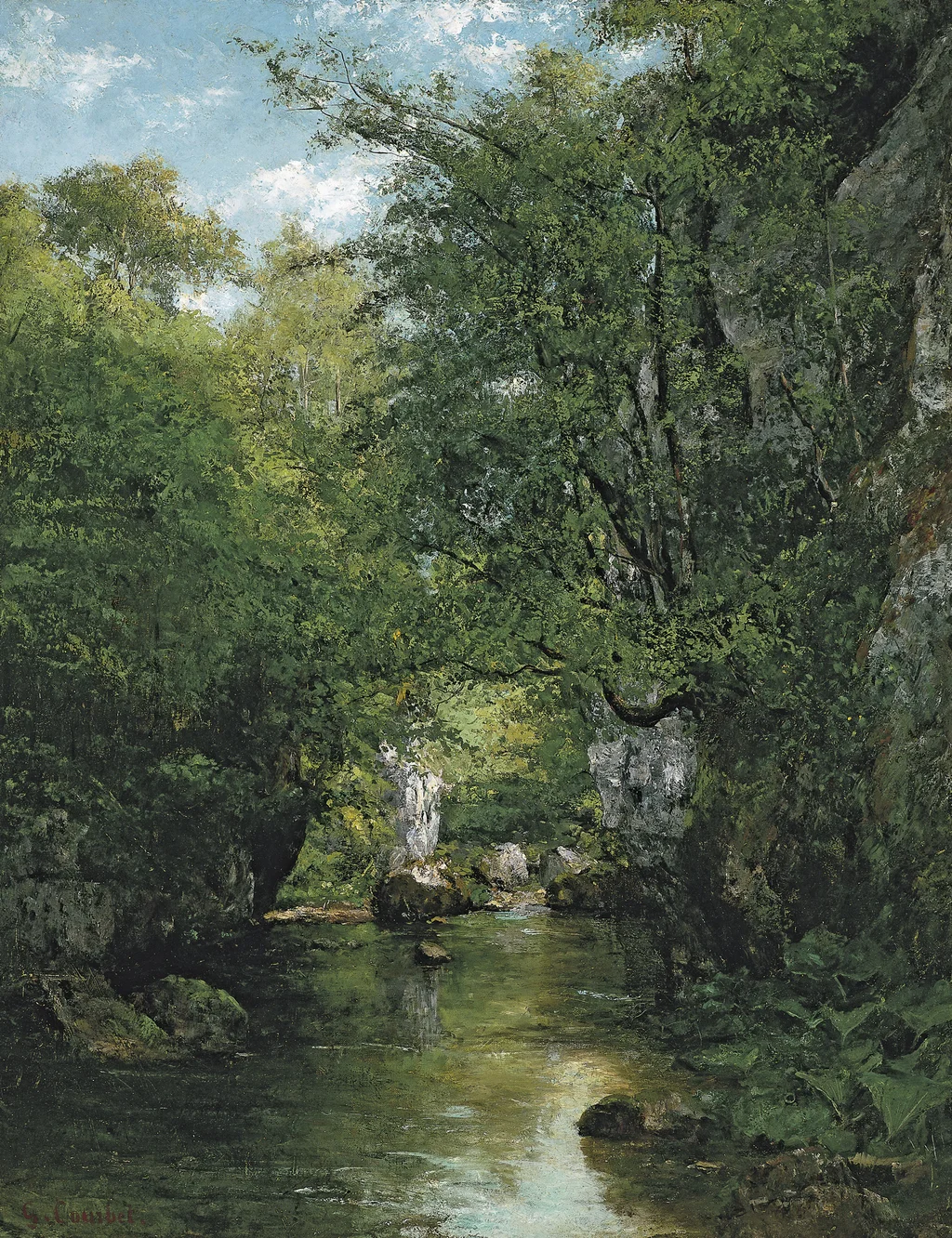
The Water Stream, La Brème
Details
The story
In 1866 Courbet had a good year at the Paris Salon, which was unusual for him. He showed four roe deer standing in the stream at Plaisir-Fontaine and the picture was well received, while his figure paintings were still being attacked. Plaisir-Fontaine runs into the Brême, a small river in the limestone country above Ornans, the town in eastern France where he was born, and in the same year he painted the Brême itself at the place called the Puits Noir, the black well, where the water comes out from under the rock.
The canvas stands upright, 114 centimetres high against 89 wide, so the view is closed in by rock and foliage instead of opening into distance. Parts of it are brushed on in broad rapid patches and other parts are laid on with a palette knife, a tool he used more and more in these landscapes. He went back to this gorge again and again through the 1860s, and other versions of it are now in museums in France and the United States.