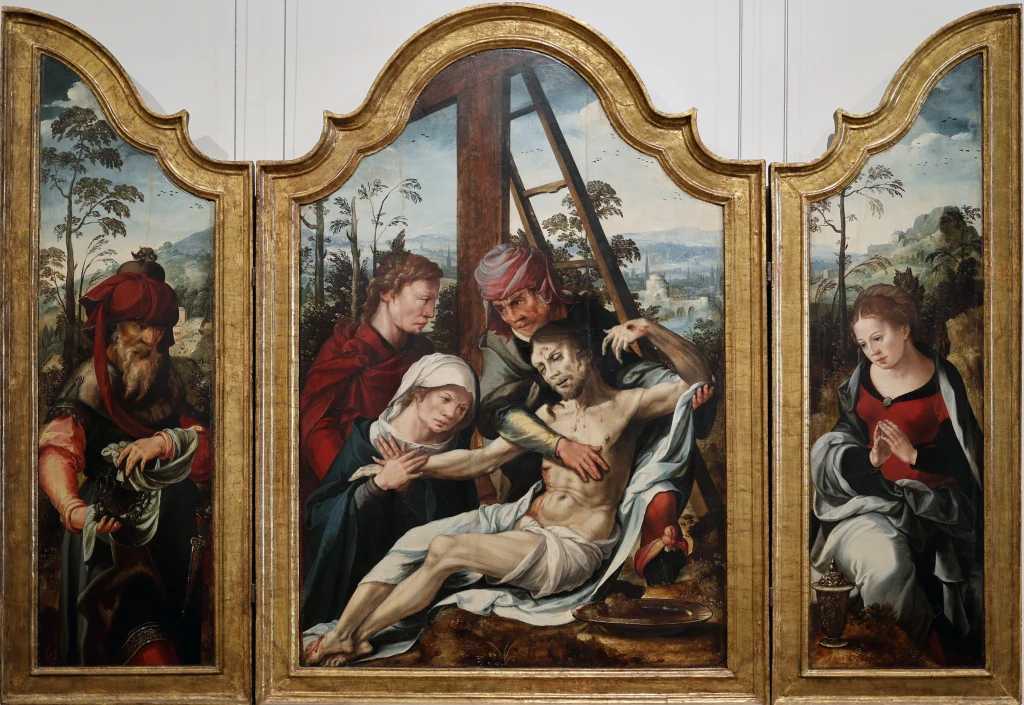
Triptych with the Deposition, Mary Magdalene and Joseph of Arimathea
Details
The story
In October 1538, in Rome, a young Portuguese painter named Francisco de Holanda listened to Michelangelo talk about the art of Flanders, and later wrote the conversation down. Flemish painting, Michelangelo said, would make the devout weep, not through any merit of the painting but through the goodness of the devout person looking at it. The museum quotes that remark in its own account of this triptych, and it fits. Everything here is laid out to move whoever kneels in front of it. In the centre Christ has just been taken down from the cross, his wounds shown openly, and around him are the crown of thorns, the sponge soaked in blood and the grieving Virgin. Joseph of Arimathea stands on the left wing and Mary Magdalene kneels on the right. The painter is not known for certain. The museum links the work to the manner of two Netherlandish masters, Pieter Coecke van Aelst of Antwerp and Maarten van Heemskerck, and dates it only to between 1540 and 1550. It also points to something that is not Flemish at all. The figures are pushed right to the front and seem squeezed by the narrow frame, a way of setting bodies in space that the museum calls more typically Italian.