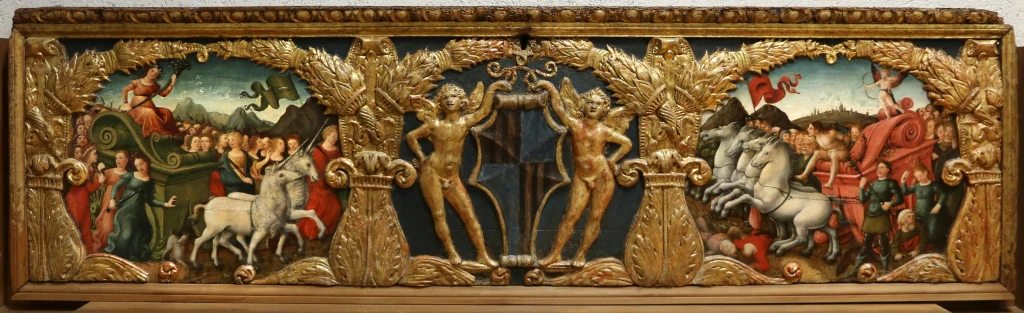
Triumph of Chastity and Triumph of Love
Details
The story
Petrarch's Triumphs, a poem of the 14th century, imagines a series of processions in which each power overcomes the one before it. Love triumphs over mankind, and then Chastity triumphs over Love. In the 15th century Italians liked to see the poem painted on their furniture, and this panel was the front of a chest. The keyhole is still visible near the top, above the coat of arms of the Sambonifacio, an old noble family of Verona.
From the left comes Chastity on a chariot drawn by white unicorns, under a banner with an ermine, followed by a crowd of virgins among whom the museum recognises Lucretia of Roman legend. Against her rides Love, pulled by bolting white horses, its banner bearing a wild boar. A naked man sits bound on the cart while Cupid takes aim behind him. Among the figures around it is Aristotle, ridden and whipped by a woman, from a medieval tale about how even the wisest of men could be enslaved by desire. Some scholars think Liberale himself brought this fashion for painted chests to Verona when he returned from Tuscany, around 1480.