Triumph of the Winter Queen: Allegory of the Just
Details
The story
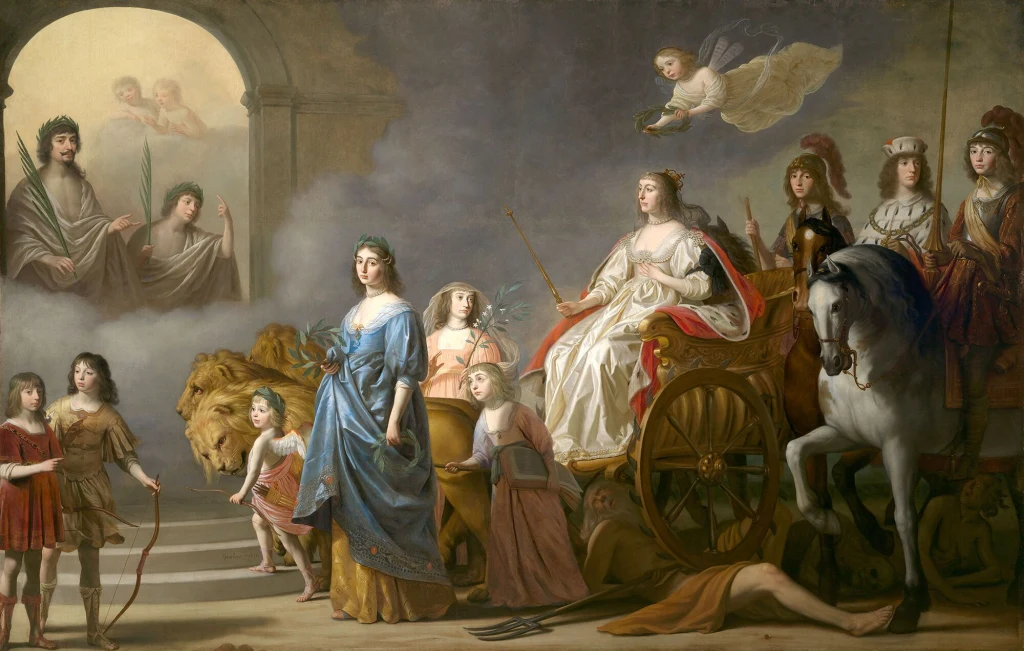
In 1636 Elizabeth Stuart had little left to celebrate. The daughter of James I of England, she had been Queen of Bohemia for a single winter, 1619 to 1620, and had lived in exile in the Dutch Republic ever since. Her husband Frederick had died four years earlier, and her brother, Charles I of England, would not go to war to win back the family's lands in Germany for her son Charles Louis. So she commissioned a triumph from Gerard van Honthorst, who painted for the courts in The Hague.
She rides in ermine on a chariot drawn by three lions, usually read as England, the Palatinate and the Dutch Republic, with the sceptre of Bohemia in her hand. Around her are her children, 13 of them, the living and the dead together. At the upper left, in golden light, her husband and their eldest son, Frederick Henry, hold palm branches. The boy had drowned in 1629, aged 15, when the boat he was on went down on the Haarlemmermeer, a great lake near Haarlem. That is why Neptune, god of the sea, lies under the spiked wheels of her chariot, along with Envy and Death.
The canvas is just over three metres high and nearly five wide. In 1998 it belonged to Prince Ernst August of Hanover, whose house descends from Elizabeth's youngest daughter, Sophia. Today it is lent to the Museum of Fine Arts by a private owner, and the museum's conservators spent 18 months cleaning it in full view of visitors before it went on show in 2013. It now fills a gallery devoted to art made in exile.