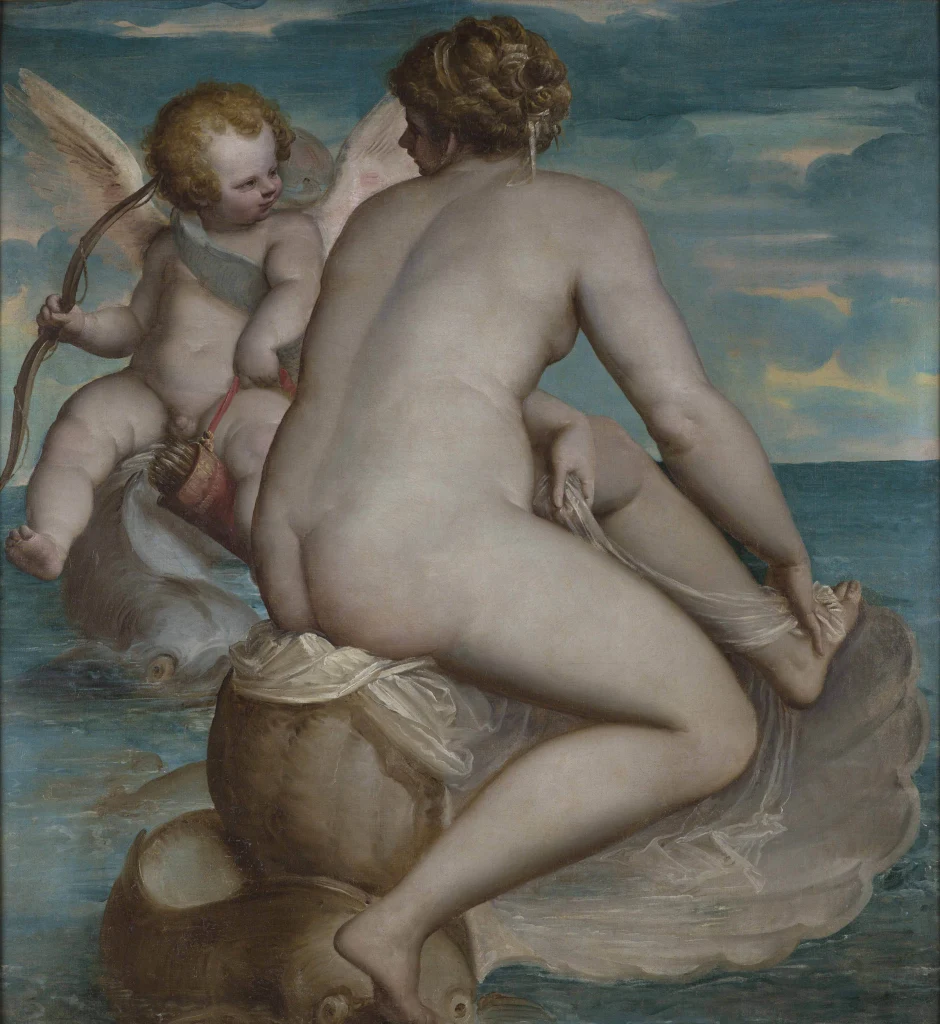
Venus and Cupid at Sea
Details
The story
The goddess turns her back to us. She sits on a huge shell that a dolphin is carrying toward the shore, gripping a thin white veil, while Cupid rides alongside with his bow and quiver. For Venus that is an odd pose, and the museum's catalogue sees a second figure behind her: Leucothea, the white goddess of Homer's Odyssey, who rises from the sea and gives the shipwrecked Odysseus her veil to keep him afloat. Hence the veil, and the milky pallor of her skin. Cambiaso painted this in Genoa around 1560 to 1565, with Venice in mind. Scholars trace the long legs to Tintoretto's bathing Susannas and the full, heavy body to the Venuses of Veronese. The Borghese inventory of 1693, which first records the canvas, saw only a naked woman sitting on a rock with a white cloth.