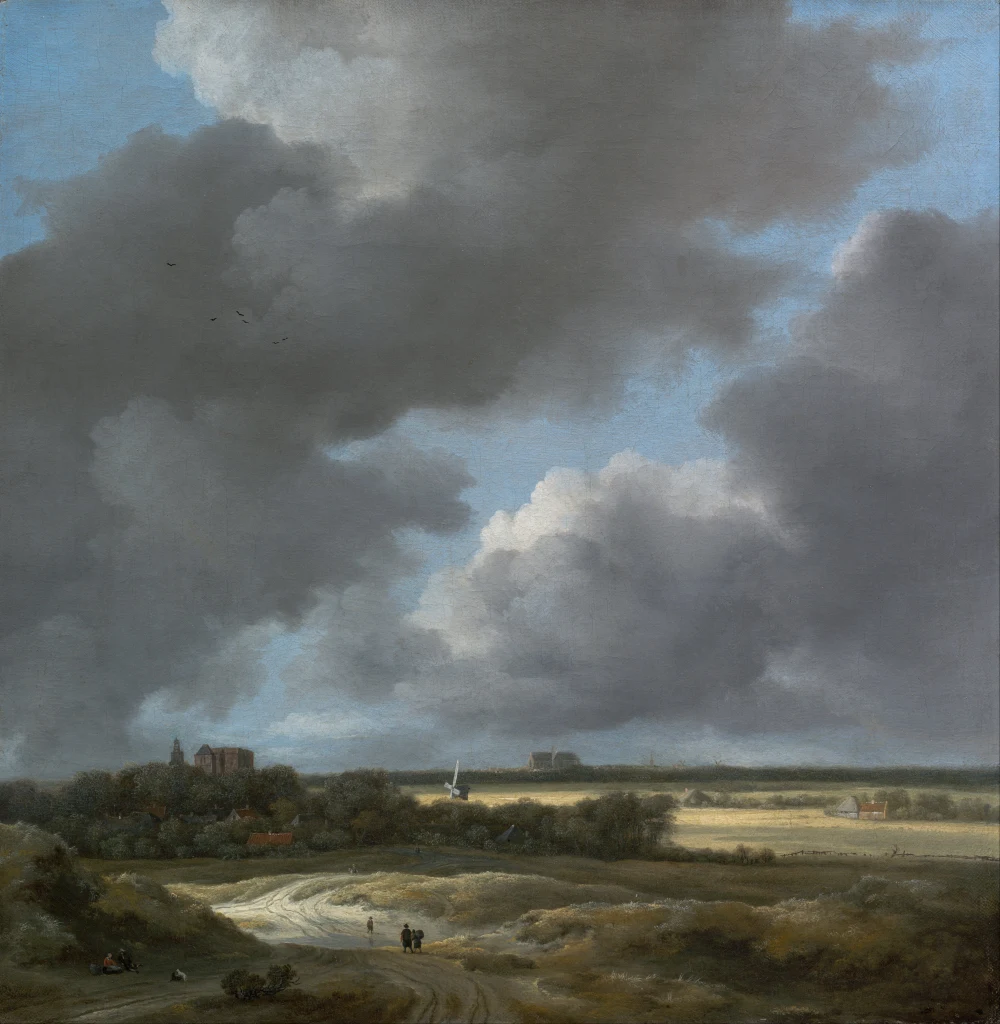
View of Alkmaar
Details
The story
Alkmaar, a market town north of Haarlem, held a special place in Dutch memory. In 1573, early in the revolt against Spain, it withstood a Spanish siege, and a saying grew up that victory began at Alkmaar. Ruisdael painted the town about a century later, sometime around 1675 to 1680, on a canvas a little over 40 centimetres high and almost square. The town lies low on the horizon, with the great church of St Lawrence rising over its roofs, and the museum points to the way he alternates bands of light and shadow across the flat land in front of it. The picture's later history runs through Napoleon's family. By 1824 it belonged to Eugène de Beauharnais, Napoleon's stepson, who had settled in Munich as Duke of Leuchtenberg, and it appeared in the printed catalogue of his gallery the following year. His descendants took the collection to Russia, and the canvas was still with a Duke of Leuchtenberg in St Petersburg in the early 1900s. The Museum of Fine Arts bought it in 1939.