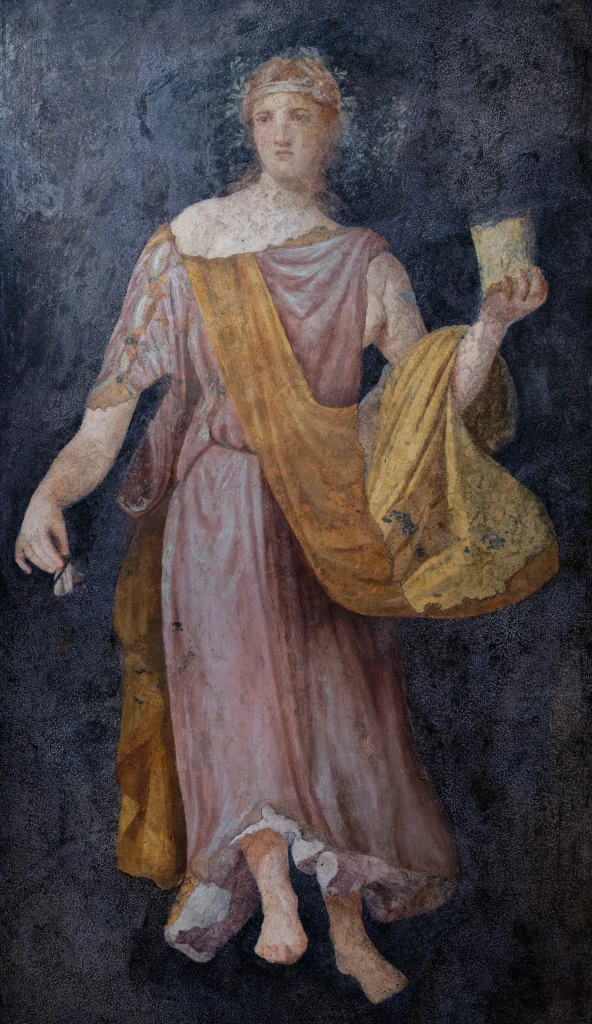
Wall Painting with a Figure of Spring
Details
The story
In 1862 the Campana collection was on show in Paris, and its guide described this as four ancient fragments set in plaster. Brought together they made a standing woman. The Campana catalogue called her the Primavera, Spring, and said she came from excavations at Tusculum, the ruined hill town above Frascati, south-east of Rome. The historian Ernest Desjardins, who wrote the guide, admired the head and the light on the skin so much that he thought of Correggio.
Look at it now and you see a whole figure, crowned with leaves, holding a cup and a few flowers. Only the head, the hands and the feet are Roman. The tunic, the drapery and much of the background were painted in later, in wax on modern plaster, and the Louvre notes that the original background was black and the restored one brown. Campana's own restorers, the Pennelli brothers chief among them, had a habit of turning scraps of ancient wall painting into complete pictures. This figure, unusually, reached Paris still in pieces and was filled in afterwards, and the Louvre's record does not say by whom or when. The museum dates the ancient pieces, with a question mark, to the last quarter of the first century AD.